
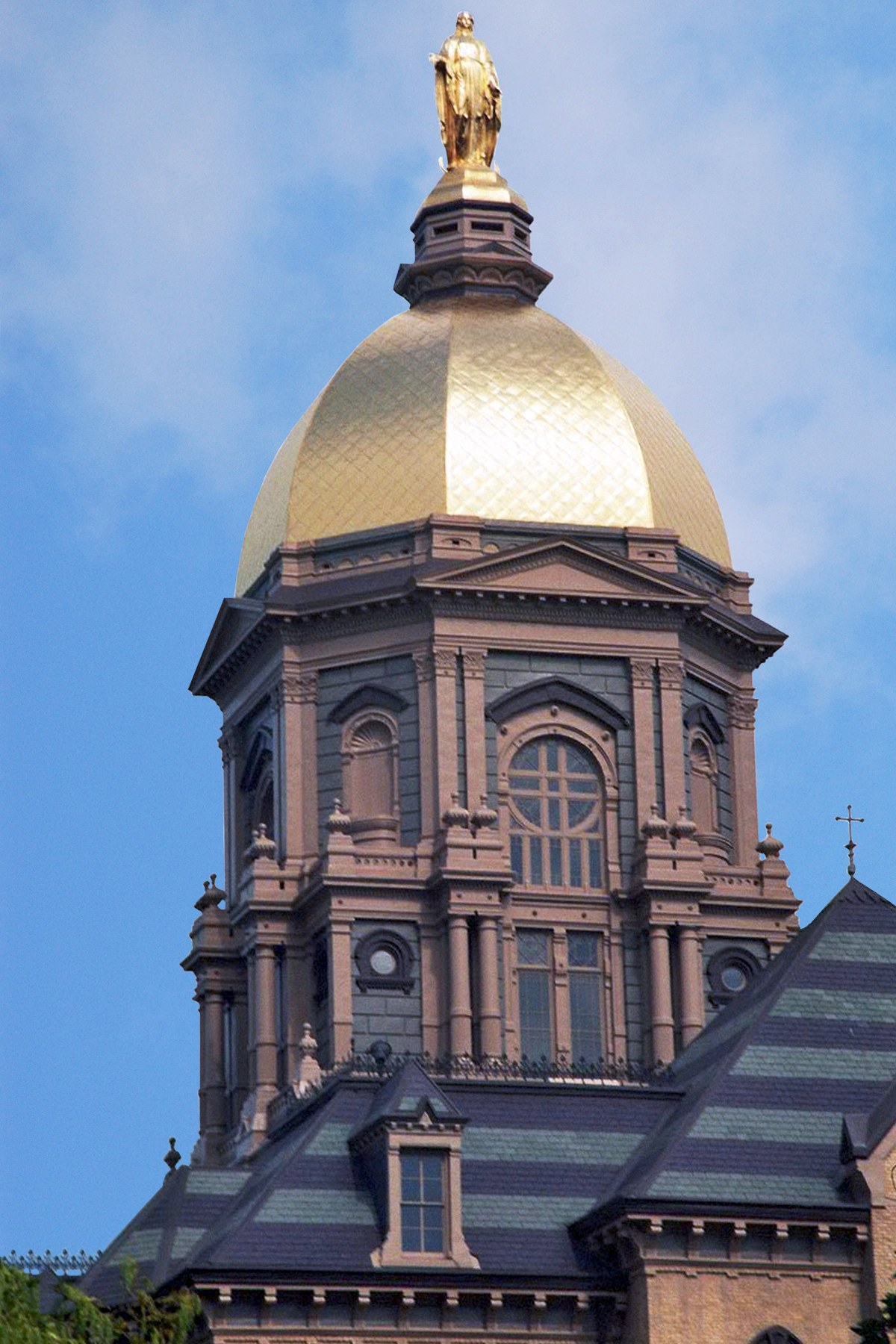
For the 19th consecutive year since its inception, the Newman Guide list of faithful Catholic colleges has excluded the University of Notre Dame from its recommendations. Based on its requirements of Catholic identity, the Newman Society still holds that they “do not feel that students will have a reasonable chance of receiving strong support in the faith” at Notre Dame.
Managed by the Cardinal Newman Society, a Catholic non-profit that promotes fidelity to the faith across Catholic education, the Newman Guide “recommends colleges for their commitment to a faithful Catholic education,” according to their website. Schools such as the University of Dallas, the Catholic University of America, and Thomas Aquinas College make up a few of the Newman Guide’s recommendations.
The Newman Society’s website lays out the criteria for being admitted to the Guide, including required thresholds of Catholic students and professors, availability of the Sacraments, single-sex student residences, a faculty profession of faith, and ideological conformity. The Newman Guide requires their recommended universities to prohibit any speakers or awardees that oppose Catholic moral teachings, and that at least 85 percent of faculty members and 80 percent of students are Catholic.
In deciding whether to add Notre Dame to the list, the Newman Society weighed the university’s Catholic character against “clear examples of opposition to the faith from many on campus.” To settle the matter, the Newman Society “spoke with the late Dr. Charles Rice, a faithful Catholic and long-time law professor at Notre Dame … [who] said that at Notre Dame, ‘a kid who is struggling with his faith will sink like a stone.’”
Professor Rice was a faculty member of the Notre Dame Law School for more than 45 years. Rice was a U.S. Marine, a consultant to the U.S. Commission on Civil Rights, and a committed Catholic and pro-life advocate. Before his passing in 2015, Rice was a vocal critic of decisions made by the university that did not reflect her Catholic character.
Rice especially took issue with the decision to invite then-President Barack Obama to be the commencement speaker at the 2009 graduation due to Obama’s support for abortion. In response, Rice penned What Happened to Notre Dame?, a short book examining how Notre Dame had departed from its Catholic roots and how it might return.
The sentiment that Notre Dame has turned its back on its Catholic identity persists among faculty and outsiders today. Last year, Dr. Christian Smith left the university and penned a First Things article detailing why he could no longer stay at a school which “fails to be Catholic.” Smith criticized Notre Dame’s faculty hiring process, institutional and faculty timidity on Catholic issues, and its focus on becoming a globally recognized research university.
Smith views the goals of being an authentically Catholic university and an elite research university as incompatible. “As Notre Dame faculty engage with the Catholic intellectual tradition, their peers elsewhere work with total focus on scholarly productivity,” Smith wrote. “Notre Dame faculty cannot be asked both to compete with their peers as scholars and to take on the extra learning and discussions that a robust Catholic mission requires. … The imperatives of Catholic mission are impediments to the success of a modern research university.”
However, several faculty members and students point to key factors that indicate not a remnant of shouldered-out Catholics, but a thriving community at the center of campus life. Professor Richard Garnett, the Paul J. Schierl Professor of Law and Director of the Program on Church, State & Society, believes strongly in Notre Dame’s ability to be a fully Catholic, elite research institution. “I believe it is clear that Notre Dame, although imperfect, is the best meaningfully and authentically Catholic institution of higher education in the world,” Professor Garnett told the Rover.
Sabrina Richter, a sophomore, ardently agreed. She told the Rover, “Having come from a large public high school, the Catholicism of Notre Dame is especially refreshing and dear to me. … There’s so much that’s so beautiful about what [Notre Dame] does have.”
Both Garnett and Richter expressed a desire to see the role of Catholicism grow in social, academic, and formational circles on campus, alongside their deep appreciation for the prominent role of the faith on campus as it stands. Professor Garnett highlighted the efforts the university is already making to improve in some of the categories the Newman Guide measures, but pointed out that some of the Newman Guide’s restrictions are “overly narrow.”
“Catholics should be aware that the [Newman] Guide excludes all but one of the Catholic R-1 universities and all of the Catholic institutions ranked in the top 50. … They should not imagine that the Newman Guide provides a full picture of the Catholic higher education landscape.”
Garnett explained, “Notre Dame is struggling, currently, when it comes to the percentage of Catholic faculty, and Fr. Dowd and Provost McGreevy have both called attention to this challenge. It is entirely appropriate for Notre Dame to take affirmative measures to identify, recruit, hire, and retain Catholic faculty and, indeed, many of our leading scholars are here precisely because of our Catholic character. It seems excessively narrow, though, to insist on a faculty percentage of 85 percent, especially given that many non-Catholic faculty can and do embrace and contribute to our distinctively Catholic mission.”
Richter emphasized the Sacraments and faith on campus. “There are times when I wish the Catholic faith and culture were more emphasized, more central to classes and the social life of the campus. But at the end of the day … I can walk down a few flights of stairs and spend time with the living God in my dorm chapel. I see religious walking the campus in their habits … the same people I casually work with in class are praying near me at one of the twenty-some odd Masses every day.”
By the numbers, Notre Dame outperforms many Newman Guide schools in their own categories. The university celebrates 158 Masses a week, more than 13 of the 15 American Newman Guide schools combined. Notre Dame has the number one theology department in the world, between 50 and 56 chapels on campus, a student body that is 80 percent Catholic, and new records for three years running of people received into the faith through OCIA and Confirmation.
In a recent article for Word on Fire, Father Gerry Olinger, C.S.C., Vice President for Student Affairs and priest-in-residence in Alumni Hall, shared the numbers behind a recent surge in the faith of Notre Dame students.
“While only 37 percent of seniors graduating from Notre Dame in 2019 reported attending religious services frequently, this number has climbed to 49 percent as of 2025,” said Fr. Olinger. “More graduating seniors are reporting that their religious beliefs are central to their life (from 56 percent in 2021 to 62 percent today), more are reporting that prayer is important to them (from 82 percent in 2021 to 94 percent today), and more are reporting that witnessing their faith to others is important (from 68 percent in 2021 to 73 percent today).”
Professor Garnett encouraged parents to look beyond the requirements of the Newman Guide and the headlines when considering Notre Dame. “No institution is perfect and every Catholic institution—including Notre Dame—falls short, from time to time. It is fair for the Newman Society and other critics to point out particular decisions and policies of Notre Dame that do not … reflect well our Catholic character and mission. But the Newman Society’s longstanding disdain for Notre Dame suggests an overly narrow understanding of what a Catholic university can be.”
“I am the parent of three Notre Dame graduates … I am entirely convinced that Notre Dame is an excellent place for engaged, curious, intelligent Catholic students to grow in their faith, and for such students who are not Catholic to discover the fullness of God’s revelation in the Church,” Garnett said.
Kolbe Barta is a sophomore economics and theology student from Texas, who takes dating advice from the humor section of the Rover. He is still single, and may be reached at kbarta3@nd.edu.