
In recent weeks, Notre Dame has been the subject of endless controversy in the media. Alumni, university faculty members, journalists, and bishops from across the country have contributed to the debate about Susan Ostermann’s recent appointment as the head of the Liu Institute for Asia and Asian Studies. Countless opinion pieces have been penned and beseeching letters addressed to administration about its apparent failure to act in accordance with Notre Dame’s Catholic identity and mission.
As students, this barrage of noise can tempt us to confusion and frustration. When many from outside the university have written Notre Dame off in disgust or given her up to secularization as a lost cause, it can seem daunting to speak up in her defense. The Ostermann appointment, after all, is only the latest in a series of administrative decisions that have been criticized by faithful Catholics.
But students of this university know better. We know that the Catholic faith is not lost at Notre Dame. Despite media scandals, administrative mistakes, and the battle of ideologies that continues to rage on campus, we know that the faith is alive and well among the student body. The ever-increasing number of converts entering OCIA, our flourishing theology department, and a vibrant sacramental life enrich Notre Dame’s campus and show that the Catholic battle is far from lost.
In a recent First Things article titled “Why I’m Done with Notre Dame,” renowned sociologist and former Notre Dame professor Christian Smith described his reasons for leaving the university. Frustrated by the administration’s failure to live up to the grand mission statement it so boldly proclaims, Smith wrote that Notre Dame “excels at being Catholic when it comes to … atmosphere, aesthetics, and worship,” but that her intellectual life, which he calls the “heart and soul of the university,” decidedly fails to be Catholic.
While Smith makes an insightful point about the necessity of the faith informing academics at Notre Dame, he is wrong that the studies, research, and teaching of the university are its “heart and soul.” It is true that they are an integral part of education, definitional to the very concept of an institution for learning. But the heart of the university, the driving force which guides her mission, informs her goals and creates her culture—the very purpose for which she exists—is her students.
It is a tragedy that in our times the student is often pushed aside and neglected for the supposedly weightier concerns of the university, treated as an accident of education and not as its purpose.
Institutions of learning are ultimately not directed at research, prestige, or even the peaks of academic excellence, but rather the formation of its students in body, mind, and spirit. A university that fulfills its purpose well does not focus on awards or rankings; nor is intellectual achievement its principal goal. Prizes and rankings are secondary goods that may indicate a school’s success, but do not alone constitute it.
It cannot and must not be forgotten that education is about the formation of an individual. The very word ‘education’ comes from the Latin verb ‘educare,’ which means ‘to lead out’ or ‘to draw forth.’ Education is inseparable from leadership. It is an endeavor that is inherently personal, and it is centered around the student. Those who educate bear the important task of leading their students toward the good, teaching them to love what is beautiful and to thirst after what is true.
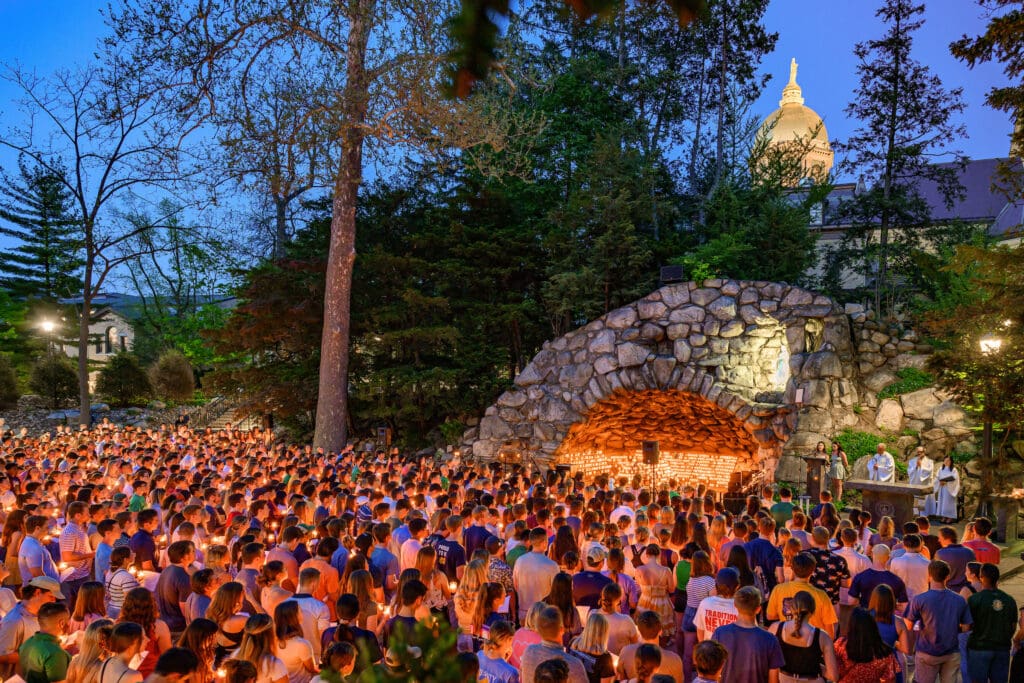
But students do not merely define the purpose of a university. They shape its culture, drive its mission, and influence the direction of its academics, policies, and extracurriculars. When most high schoolers visit a prospective college choice, they don’t ask to read the mission statement. They soak in the experience of being on campus—of being a student, surrounded by other students. They observe whether the people walking to class are smiling or merely glued to their phones, whether campus is bustling and energetic or dull and unalive. In the case of Notre Dame, they also see the crowd of students filling the basilica for Mass, the Grotto flickering with candles, and countless other signs of faith—from thousands of students kneeling for Mass at an ice chapel to a nightly Rosary that takes place regardless of frigid temperatures.
Notre Dame exists for her students. In seeking to educate them, she must also be formed by them, as the mind must always be informed by the heart.
The power we have as students in shaping the university should not be underestimated. And thus, we also bear a great responsibility to lead the administration that exists for our education’s sake. We have the privilege and the task of holding our university accountable, requiring that it act in accord with its professed identity.
Perhaps now more than ever, this task is urgent. The students who participate in the university’s flourishing sacramental life, who brave South Bend winter nights to pray the Rosary or go to Mass, and who bear witness to the strong life of faith that permeates work, prayer, and study on campus, must hold their university accountable to live up to her mission.
By appointing Ostermann as head of the Liu Institute, Notre Dame’s administration is failing its students, and they should not take this failure lightly. Students deserve leaders who will live out the Catholicism that they advertise and who will stay true to Catholic teaching in a world of competing secular universities. At minimum, Notre Dame’s students deserve administrators who match the level of faith that they themselves show every day. And it is their unique responsibility to demand it.
Notre Dame’s heart is not found in the approval of worldly institutions, the academic research she carries out, or the fame she earns by her achievements. The heart and soul of this university is her students. And it is an insult to them when those in authority treat the mission that the student body wholeheartedly believes in with such contempt. If those in positions of power at Notre Dame will not lead, they are failing to educate their students.
Catholicism is alive and well at Notre Dame, because it is alive and well in her students. But it is time that the student body stops meekly allowing its administration to act against the values that define a Notre Dame education. If the leaders will not lead, we must. We Notre Dame students should demand that we be formed in the values that are intrinsic to our university’s mission. We ought not to settle for a subpar education focused on worldly standards, but instead require those in authority to offer us true leadership, a formation towards the good.
As a student of Our Lady’s university, I challenge my peers to not give up on our beloved Notre Dame. We will not cease to defend her and fight for her, showing those who would give up that the spirit of faith on campus has not been extinguished. We must also do everything in our power to preserve that faith in the actions of our administration. Schedule office hours with the president; participate in this week’s ‘March on the Dome’ to protest the Ostermann appointment; send emails and letters to the provost; write opinion pieces in the student newspapers. And above all, pray. Pray that Notre Dame may be a witness to the faith, that those in authority will make policies and decisions in alignment with her Catholic mission.
The faith of the students of Notre Dame testifies that Catholicism is far from lost at our university. By the grace of God, may we have the courage to preserve that faith for years to come.
Abby Strelow is a sophomore majoring in theology and the Program of Liberal Studies. She can be reached at astrelow@nd.edu.