
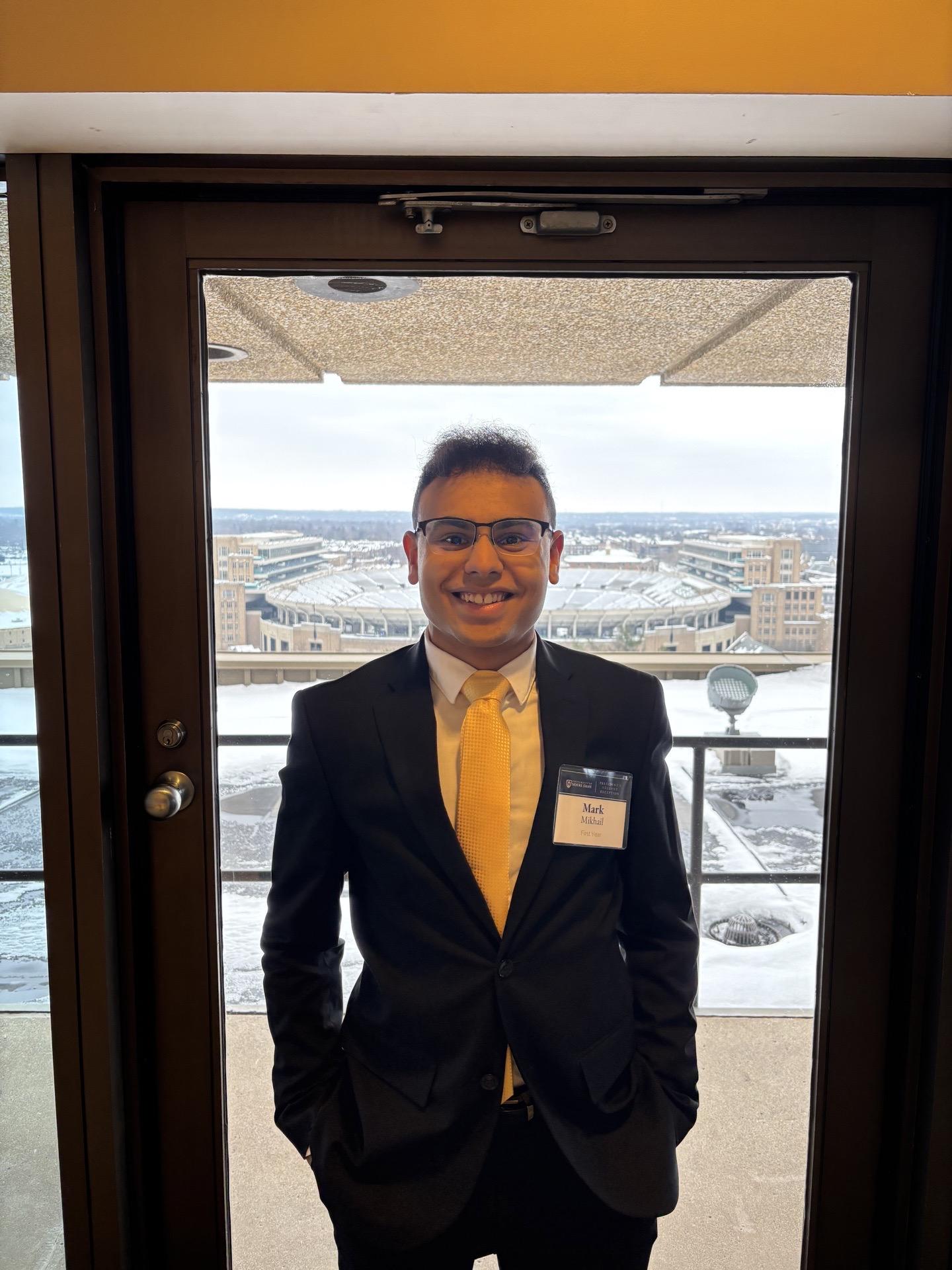
Notre Dame sophomore Mark Mikhail was arrested by ICE agents at Los Angeles International Airport (LAX) on Friday, October 23, while traveling back to campus. Federal immigration officers transported Mikhail to a detention facility in Adelanto, California, where he was held for three nights before his release on Tuesday, October 27.
Originally from Egypt, and seeking asylum in the U.S. based on persecution of Coptic Orthodox Christians in Egypt, Mikhail lives with his family in California.
On campus, Mikhail serves as president of the undergraduate Maritain Fellows. He studies biology and theology and lives in O’Neill Family Hall.
Mikhail shared the story of his arrest and detention in an interview with the Rover.
A man who identified himself as an airport staff member approached Mikhail while he was sitting at his gate in LAX and asked to speak with him around the corner. “I was confused, but then I went. I naively trusted him because of the airport tag.”
“He showed me his ICE badge around the corner … and then two more officers showed up and then they were asking me for my papers.” The agents told Mikhail they had obtained an arrest warrant against him.
“I showed them my papers. I gave them my ID. But I was very respectful with them, and I received the same treatment with them being respectful, but obviously it was very intimidating, just three officers showing up around the corner kind of surrounding you.”
Mikhail described the officers as wearing civilian clothes. When he asked to take pictures of them or their badges, they refused. The officers then escorted Mikhail outside of the airport, handcuffed him, and transported him in a van to a detention facility in downtown Los Angeles.
Mikhail said that he talked with the officers about Notre Dame and their families and tried to show that he cared about them. “When I went to this LA facility, everybody treated me very well. They asked if I needed any water, food, wanted to make any calls, and they gave me so much time to make my phone calls.”
However, Mikhail described conditions at the facility as miserable. “I was held in a fairly small prison cell with two other people. They gave us a very tiny mattress to sleep on, and then an emergency blanket, and the bathrooms were exposed.” Mikhail added, “At the first facility, I did not have anything with me … not even my bracelet or cross necklace or anything like that.”
“Through all of this, I knew that I was suffering with Christ and for Christ. There’s a passage that me and my friends have talked about before. It’s in 1 Peter 2:18–25. St. Peter’s telling us that it’s commendable for us to suffer unjustly because Christ himself suffered unjustly. And so that passage was in my heart throughout the whole ordeal, and it comforted me a lot.”
According to Mikhail, the kind treatment he received upon his arrival at the Los Angeles detention facility changed Saturday morning when the first group of officers changed shifts. In a statement shared with the Rover, Mikhail wrote that he was handcuffed and placed in chains around his waist and legs to be transported to a second immigration detention facility in Adelanto, California.
“It was just one huge room, like imagine a high school gym. Imagine 88 beds. Some are bunk beds, some are normal beds, and just people in bathrooms in the back, a microwave at the front, and two TVs and a library.” Like in the first facility, Mikhail had none of his personal belongings. He obtained a Bible from the library.
Mikhail described meeting multiple people at the Adelanto facility. “I met a person who graduated from UCLA, and he works a very high esteemed job at Amazon. … I met a person who graduated from UC Santa Barbara who came into the U.S. [when he was] a few months old. I met an old man who was 80 years old, and then another Coptic person who was able to give me a lot of strength and a lot of hope.” Mikhail requested prayers for these people.
On Monday night, Mikhail called his friends at Notre Dame. They were busy writing a letter to university president Father Robert Dowd, C.S.C. about his arrest. “I didn’t know that they were writing a letter for me. It was very wonderful just to talk to them, but honestly, those phone calls, with my parents and family and friends really made this experience so different. It would have been so hard for me without contact with them.”
When he first arrived at the Adelanto facility, Mikhail’s intake process was not completed. He was unable to make phone calls with his own PIN code until Tuesday. He instead used other detainees’ PIN codes to make phone calls during this time. Consequently, Mikhail could not contact his lawyer until Monday, three days after his arrest.
The following day, on Tuesday, October 27, Mikhail was released from detention.
Mikhail first asked himself, “How am I being released? My lawyer hasn’t submitted any papers or any application or anything. I don’t know how.”
“The ICE officers and the security guard of the prison did not know how, they don’t know why, and to this day, my lawyer doesn’t know how, I don’t know why, and nobody knows why. So it is by all means a miracle.”
Mikhail described the outpouring of support he has received since his release. “There were hundreds of people that texted me. … There were people that cried for me and people that couldn’t sleep for me. Just seeing that much love proves that there’s so much Christ-likeness out there.”
“The people that I know are so beautiful, and I don’t deserve any of them and the love that they have in their hearts. And this is just a glimpse of heaven and a glimpse of the fellowship of the saints.”
In a statement shared with the Rover, Mikhail wrote, “I ask anybody who hears about my story not to participate in hate speech or any form of disrespectful speech towards ICE as an agency or any workers of ICE. I forgive ICE and any ICE officer or prison guards; I love them, and I want to serve at their feet. This is the most important principle of my faith that I came to fully and freely practice here.”
Mikhail returned to Notre Dame’s campus on Friday, October 30. He must wear a GPS monitor on his leg and is unsure of when it will be removed.
Gabe Hockstra is a sophomore from northern Virginia studying economics and history. He can be reached at ghockstr@nd.edu.