
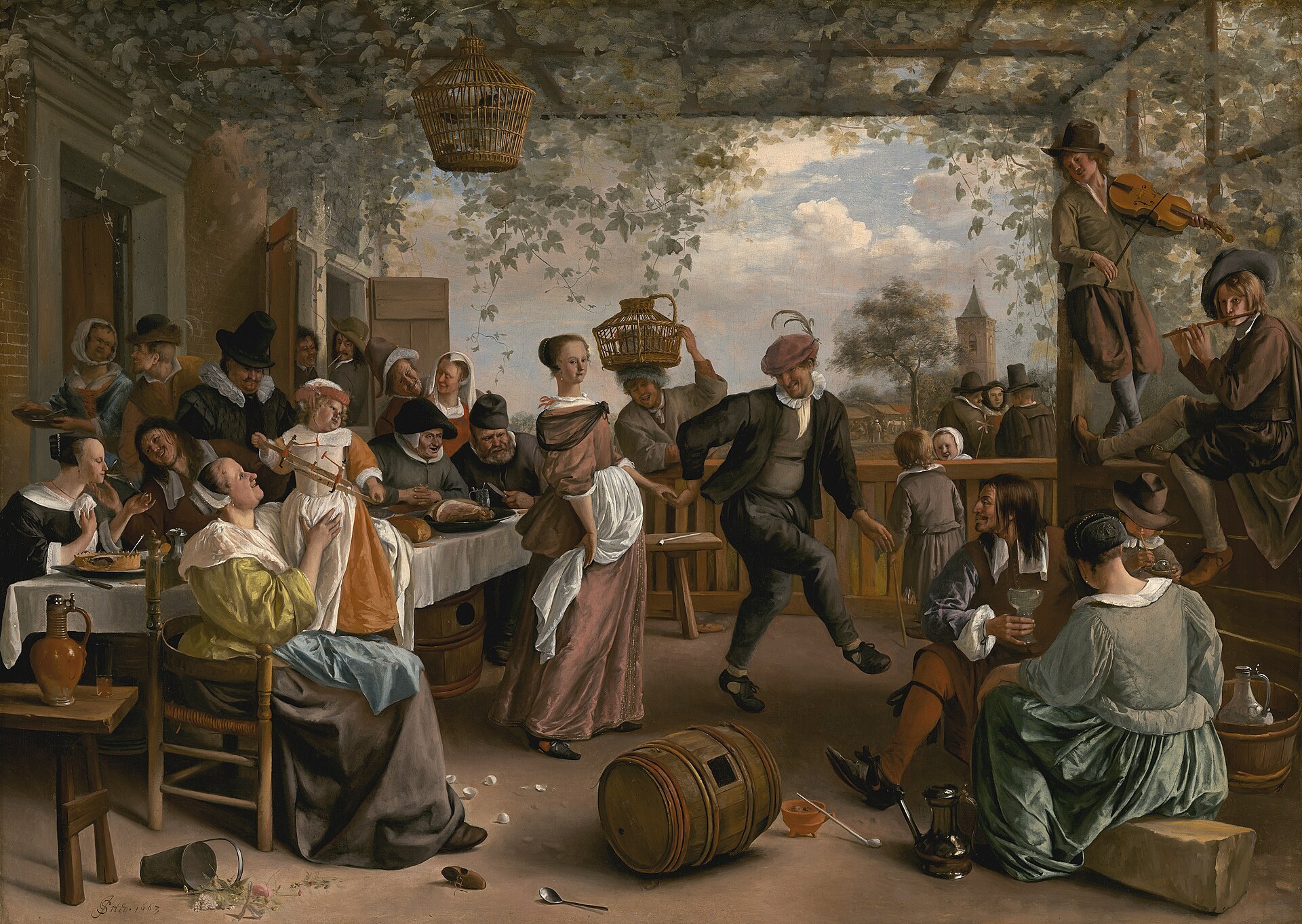
The typical Saturday night and Sunday morning of a Notre Dame student present a sharp juxtaposition. Students who, the night before, bustled to and from packed dorm parties with loud music, dancing, heavy drinking, and other inappropriate behavior, now go to and from the Basilica for Sunday Mass. While the contrast between Mass and a dorm party is obvious, it seems many do not see any problem with this kind of recreation. After all, what’s wrong with a late night out?
Several weeks ago, the Rover published a piece by Notre Dame alumnus James Thunder titled, “A Rule of Thumb From Augustine.” In the article, Thunder shared two methods for avoiding the near occasion of sin, given to him by a priest as a young man: “‘Do not do in a crowd what you would not do alone,’ and ‘Do not do at night what you would not do in the day.’”
A typical dorm party puts us in danger of transgressing both of these rules. Not only does being in the presence of a lively, often intoxicated, crowd tend to lower one’s inhibitions, but the fact that parties often stretch well into the night means that one attending these gatherings will often do so while particularly tired, which again weakens one’s ability to act prudently and resist temptation. Moreover, the features of a dorm party order it toward intemperance. It is hard to imagine how drinking games or homemade “jungle-juice” with an unknown ABV would serve any purpose other than excess.
As further evidence, readers might recall the kinds of imprudent behavior they have witnessed others engage in during or as a result of these kinds of gatherings.
Besides parties, another characteristic social event at Notre Dame deserves attention. Namely, SYRs, formals, and other couples dances.
SYRs and formals pose a similar risk as dorm parties. But, what about other kinds of couples dances—such as swing dances?
The Church and her saints have opposed dances between unmarried couples throughout the ages. Notable examples include: Origen, St. Ambrose, St. Augustine, St. John Chrysostom, St. Anthony of Florence, the Council of Trent, St. Charles Borromeo, St. Francis de Sales, St. Alphonsus Liguori, St. John Marie Vianney, and St. Anthony Mary Claret.
These saints opposed dancing, not out of a puritanical spirit, but out of a zeal for souls. It is true that partner dancing took different forms in the time of these saints—some were more promiscuous—but others, like those in the time of St. Charles Borromeo, were quite similar to or even more conservative than modern swing dancing. Regardless, this consistency across the saints suggests they opposed dancing in principle, as opposed to a specific time period’s style of dance.
As with parties, these saints opposed dancing because they saw it as leading to sins of impurity. St. John Vianney, for example, warned his parishioners regarding dancing, “Is it not in these gatherings that people are most violently prompted against the holy virtue of purity?”
It is also true that these saints by-and-large wrote in times in which society’s sexual ethic was in much greater conformity to that of the Church. Today, given that society’s moral standard has severely degraded, Catholics may be tempted to dismiss what they perceive as antiquated perspectives on sexuality. However, society’s drift in morals does not permit us Catholics to drift also.
As one priest of the Priestly Fraternity of St. Peter explains, “Just because there are many things in society that are more immodest than dancing, and that lead to impurity, that doesn’t mean that unmarried [men] and [women] dancing together isn’t immodest and won’t lead to impurity.”
In sum, a Catholic’s moral compass is not relative to society’s. While the world’s values change, the Church’s do not.
We must consider whether or not attending dances and dorm parties is a wise decision, or if it places us in a situation in which the already-fierce temptations of the world, the flesh, and the devil, will become all the more severe.
The Church does not advocate for an observance of the faith deprived of joy. On the contrary, Catholics should be joyful witnesses to our Lord Jesus Christ. Catholics can—and should—pursue opportunities for community and leisure. However, not every recreational activity that we might enjoy brings us closer to the “peace which passes all understanding” (Philippians 4:7).
Ultimately, we need to ask ourselves the question, “What would I give up for Christ?” If, out of humility and reverence for the teachings of the Church’s saints, we conclude that parties and dances tempt us to evil, we must be willing to give them up. As Our Lord exhorts us, “If your right hand causes you to sin, cut it off and throw it away. It is better for you to lose one of your members than to have your whole body go into Gehenna” (Matthew 5:30).
Andrew Blake is a junior from Minnesota studying PLS. In order to help avert his inevitable unemployment after graduation, please send job openings at local dance halls to ablake5@nd.edu.
Ned Kerwin is a senior from Manhattan studying theology. He has recently taken a liking to speaking Spanish, though he has a very limited vocabulary. In order to immerse himself in Spanish-speaking culture, he is trying to learn the tango. Please send relevant advice to ekerwin@nd.edu.