
What began at Stanford in 1987 as a 500-person protest against white and Eurocentric teaching of history led to a fundamental shift in American history education. Less than a year after the protest, Stanford changed its required freshman course to a more diverse and global survey to avoid the infamous “European-Western and male bias” and “sexist and racist stereotypes.”
As survey courses faded in importance, their allegedly problematic omissions became a focal point of history departments across the country. Increasingly, the history of women, race, and ethnicity—and more recently the history of sexuality—has grown to inhabit a far larger share of course offerings in history departments across the country.
At the same time, however, history departments both at Notre Dame and beyond have faced dwindling enrollment.
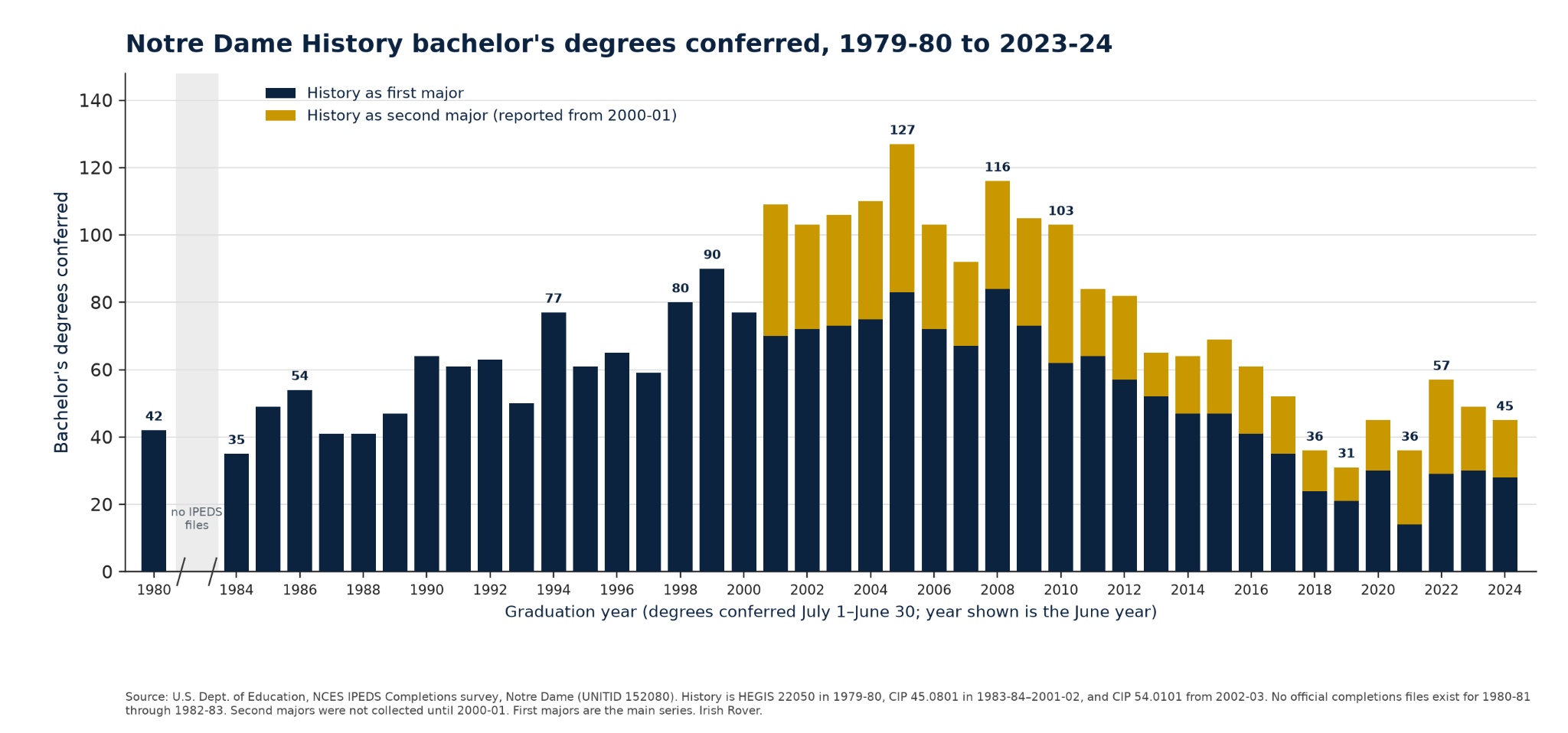
Conferral of history degrees at Notre Dame peaked in 2005 at 127 students. In 2024, that number had dropped to 45.
History majors are required to take 10 courses, including five elective courses, three of which must fit within a geographical or thematic concentration chosen by the student.
Until Spring 2026, Notre Dame’s history website said, “Thematic concentrators will choose from thematic pathways that fit particular strengths within the department, such as Business and Economic History; the History of Religion; Global Empires; the Medieval World.” It clarifies that these options are not exhaustive, “Students may also petition the Director of Undergraduate Studies to shape their own concentration.”
According to Director of Undergraduate Studies Lisa Lillie, the most popular of these concentrations are North American history, European history, and the History of Law.
In Fall 2026, the website added “Gender and Sexuality” and “History of Race” to its thematic offerings. Each concentration requires three related elective classes. Course offerings that count towards these concentrations include titles like “From homosexual to LGBTQIA+: How we got queer in the USA, 1920—present” and “African American Resistance.” Courses with the HTGS (gender studies) and HTRA (race) attributes represent just 382 seats out of 17,056 filled seats in the history department since 2020.
These courses have an average fill rate of 69 percent, in contrast to the 79 percent fill rate across all undergraduate history courses over the same time period. Out of every course with the gender studies or race attributes, only one course has reached full capacity since 2020: “Race and American Popular Culture” in Fall 2021. Lillie noted an “ebb and flow” in the popularity of certain history topics. The early 2020s were a particularly hot time for racial topics.
History Department Chair Darren Dochuk believes that, in past decades, there has been an increase in faculty desire to teach specialized courses. He noted, however, that faculty have indicated an interest in teaching more survey style courses in recent years.
Notre Dame has never had a blanket Western Civ requirement for all freshmen, but the university included a history requirement in the Core Curriculum until 2018, when that requirement expanded to include history or the social sciences. In that same year, the course Western Civ I/II fell from 129 students in 2017–18 to 55 students in 2018–19. In the semesters since, enrollment in Western Civ has remained a shade of its former numbers.
The core curriculum history credit can be fulfilled with any course carrying the WKHI attribute in PATH, including those not listed in the history department. In Spring 2027, this list of courses includes “Reproductive Injustice: Race, Gender, and Medicine in the United States 1900-Present.” The course’s description reads, “Grounded in Black feminist scholarship and the histories of reproductive oppression and resistance, the course adopts a comparative approach to understanding how race, gender, class, colonialism, immigration, and state power have shaped the reproductive experiences of Black, Latina, Indigenous, Asian American, and other women of color.”
“Western Civilization to 1500” has not been offered since Fall 2025, but a class is open for Spring 2027 registration under a new title, “Traditions and Encounters in Global History to 1500.” No longer focusing only on western civilization, the new course will “range widely from ancient Mesopotamia to China, India, the Islamic Middle East, and Western Europe with stops along the way in the Western Hemisphere,” according to its description on PATH.
The Rover spoke to several people close to the matter.
According to Dochuk, “in the last 10 years … the big survey class has been diminished in importance in undergraduate education.”
He continued, “I think functionally a lot of that has to do with how many students were coming in with that credit already.” Lillie and Father Wilson Miscamble, C.S.C., Professor Emeritus and former history Department Chair, echoed this sentiment.
Advanced Placement (AP) allows high school students to take more challenging courses in high school that are accepted for credit at most universities. The primary AP history offerings were World History, U.S. History, and European History. Beginning in 2024, AP African American Studies has also been offered nationwide.
With these surveys completed, many students enter college looking to take more specialized courses. Class offerings are also largely decided by faculty interest and specialty. Lillie told the Rover that the Undergraduate Studies Committee, which selects course offerings, has to play a balancing act “between what students want and what [faculty] think … will make them well-rounded individuals who will take that degree and help make them more marketable [after graduation].”
Each history major is required to take a History Workshop course, often completed freshman year, which the history department website describes as “an introductory seminar in which new majors learn why and how historians study the past.” Regarding this course, one history student told the Rover, “I was very much writing what I thought the professor needed to hear.” He continued, “And that’s true for all basic seminars that history majors have to take.” History majors must take three seminar courses, including the introductory history workshop.
Lillie told the Rover, “We’re alive to national trends, of course, but at the same time, I think Notre Dame is in an industry leading position.”
Caleb Vaughan is a chemical engineering major from Orono, MN. If memory serves, he can answer questions about Minnesota history, the topic of his 6th grade social studies class. To inquire, reach cvaugha2@nd.edu.