New secretary of USCCB speaks to Rover on law, compassion
The United States Conference of Catholic Bishops (USCCB) stepped into the national spotlight on November 12 when it released a “Special Message” on immigration during its annual Fall Plenary Assembly in Baltimore.
The USCCB rarely issues a statement of this kind, a practice that requires two-thirds approval from all U.S. bishops. The last time this occurred was in 2013, when the bishops condemned the contraception mandates imposed by Obamacare. The recent message on immigration received an overwhelming 216 confirming votes, with only five votes against the measure and three abstaining.
Opposing the “indiscriminate mass deportations of people,” the message expressed solidarity with immigrants and a desire for “meaningful immigration reform.” The bishops’ concerns mentioned the “conditions in detention centers and lack of access to pastoral care,” the “climate of fear and anxiety around questions of profiling and immigration enforcement,” and the “threat against the sanctity of houses of worship.”
The message ended, “We pray for an end to dehumanizing rhetoric and violence, whether directed at immigrants or at law enforcement.” Unlike the 2013 message, which mentioned the Obama administration explicitly, the immigration message did not mention President Trump or his policies by name.
The bishops’ statement adds to the national scrutiny of the Trump administration’s efforts to deport the estimated 1.7 million immigrants who crossed the border illegally under the Biden administration. In response to the USCCB’s statement, border czar and practicing Catholic Tom Homan told EWTN, “[The] Catholic Church is wrong. I’m sorry. I’m a lifelong Catholic. I’m saying it as not only a border czar. I’ll say it as a Catholic. I think they need to spend time fixing the Catholic Church in my opinion.”
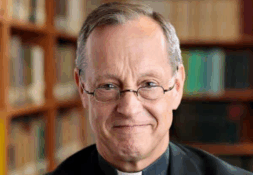
Bishop Kevin Rhoades of the Diocese of Fort Wayne-South Bend, newly-appointed Secretary of the USCCB, spoke at the law school on November 17 in a talk titled, “Religious Liberty, Immigration, and the Catholic Church.” Recently returned from the Baltimore assembly, the bishop discussed the necessary balance between ordered law and Christian compassion.
“[The bishops] truly do recognize our nation’s responsibility to regulate its borders and to have a just and orderly immigration system for the common good,” Bp. Rhoades said. “We note that without such processes, immigrants face the risk of trafficking and other forms of exploitation.”
Various Catholic charities have faced federal opposition in recent years for their humanitarian services to migrant communities. As Bp. Rhoades explained, the proposed “Secure the Border Act” of 2023 attempted to “restrict religious organizations from accessing federal funding for [their] services to migrants.”
This would prohibit providing illegal immigrants with basic needs, Bp. Rhoades explained. “[The USCCB Committee on Religious Liberty] vigorously opposed this proposed legislation because it considered providing humanitarian aid—like food, water, and shelter—as facilitation of unlawful entry. It would defund transportation, lodging, or immigration legal services to undocumented immigrants.”
The act passed the House of Representatives but failed to advance in the Senate during the 118th Congress.
“Ministry to migrants is not peripheral to the work of the Church. It’s part of Christian discipleship,” Bp. Rhoades clarified. “We’ve tried to advocate with Congress to clarify that merely serving vulnerable persons does not constitute harboring, and that religious charities have the freedom to serve without discriminating on the basis of immigration status.”
But religious persecution goes beyond charitable services, Bp. Rhoades explained. He described an incident in Chicago where priests leading a Eucharistic procession were denied access to an Immigrations and Customs Enforcement Agents (ICE) facility holding illegal immigrants. After going through proper protocol for visitors of detainment centers, the Catholic priests were still denied entrance. “One shouldn’t lose their right to worship,” Bp. Rhoades said.
Bp. Rhoades recognized the politically charged nature of the immigration debate, but emphasized the precedence of faith. “There are some who are so taken by the ideology of the left or the right that what the Church says is secondary to their ideology. That’s very troubling, because I’m always saying, ‘Be Catholic first, be a disciple of Jesus first, before being a Democrat or being a Republican.’”
“Our focus needs to be living the Gospel, and it’s really the job of the laity—having good lawyers and those who are involved in this in politics—to have their faith inform their consciences, and their work, and their lives.”
While Bp. Rhoades supported the need for secure borders, he emphasized the need for compassion as well, saying, “It was wrong to come [illegally] but some of [immigrants] were in desperate straits. Some of them came because they were in dire poverty, or they were fleeing violence. I know Central Americans … whose parents have told me the reason they came into our country illegally was because if not, their children—teenagers—were being coerced into drug cartels, and that if they didn’t, they’d be killed.”
“What would I do as a parent?” Bp. Rhoades asked. “I’d want to get them out of that situation. So these are really human issues. It’s not so black and white.”
In an interview with Rover following the lecture, Bp. Rhoades clarified that the problem of scale in the immigration debate in no way lessens the humanity of the illegal immigrants. “So what’s the reaction? We have all these people—they’re still human beings.”
“Biden obviously didn’t help matters by not having proper security,” Bp. Rhoades added. “But at the same time now, we can’t just kind of say that everyone who crossed … should be deported. There should be due process … for everyone. They shouldn’t lose that right.”
“Maybe in the end, they wouldn’t be allowed to stay. But maybe they would be, depending on whether they qualify, for example, for asylum,” Bp. Rhoades told the Rover. “Some would, I’m convinced.”
Samuel Mahut, a Ph.D. student in philosophy visiting from the Catholic University in Ružomberok, Slovakia, raised personal concerns based on his experience in Europe. He told the Rover, “Generally, especially in the Catholic Church, believers [have] open hearts. They know that it’s necessary—and even our Christian duty—to help others. However, there is a question of borders and of safety.”
“I’m from Europe,” Mahut added, “And especially in Germany and France—where the policy was to open the borders, to welcome everybody without … trying to integrate [them] into society—sometimes the immigrants, especially from Arabic countries, they [don’t] behave very politely. Now there are some parts of towns where it’s dangerous to go, even for police. … Because there are a lot of … immigrants from Arabic countries and the climate there is not so safe to live there, to move there.”
Third-year law student John Paul Beckman offered a more favorable interpretation of the bishop’s statement, telling the Rover, “The USCCB made known the gravity of the situation immigrants are facing both through the content of their message, and through its medium, namely, the rare ‘special message.’ They are encouraging our leaders to see to the protection of the country, but imploring them not to forget to respect the dignity of every person, citizen and immigrant.”
Lucy Spence is a junior majoring in piano performance and the Program of Liberal Studies, with a minor in philosophy. You can her at lspence@nd.edu.
Photo Credit: Matt Cashore / University of Notre Dame
Subscribe to the Irish Rover here.
Donate to the Irish Rover here.