
Last October, Harvard Dean of Undergraduate Education Amanda Claybaugh released a report on the problem of grade inflation at the Ivy League university. While the issue of grade inflation has always been nuanced, the data tells a clear story. The number of A’s given out at Harvard nearly tripled over a period of twenty years, rising from 24 percent of grades awarded to 60 percent. The report noted that “a 4.0 is no longer a goal … but rather a default.” Claybaugh’s conclusion: Harvard’s grading practices were undermining its academic mission.
The situation at Harvard is not unique: concerns that grade inflation is creeping from K-12 education into higher education abound. In 2013, the Rover reported on grade inflation at Notre Dame, citing the apprehensions of faculty members as they attempted to combat its rise. The problem has only intensified since then.
The trend of grade inflation is identifiable empirically in the increase in Grade Point Average (GPA) cutoffs for qualifying for the Dean’s List, an honor bestowed on the top 30 percent of students in each undergraduate college. The average GPA across all colleges in the fall of 2015 was a 3.71. Over the past ten years, that has risen to a 3.881. This change is independent from any grading policy changes—Notre Dame’s current grading scale was enacted in 2012. Trends like these prompt many questions surrounding the strictness of grading and the expectations given to students at prestigious universities.
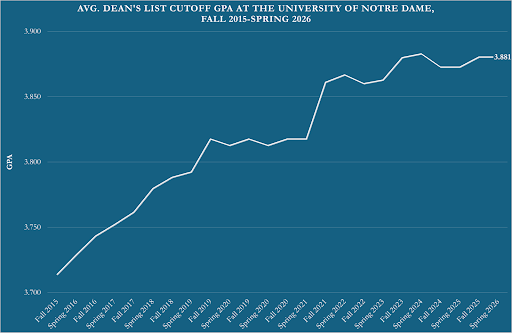
This chart displays the growth of the average Dean’s List Cutoff GPA across undergraduate colleges (College of Arts & Letters, Mendoza College of Business, College of Science, College of Architecture, College of Engineering, and the Keough School of Global Affairs) at the University of Notre Dame. Notes: (1) In the data, First-Year Studies is classified as one of the undergraduate colleges and (2) The Keough School of Global Affairs began reporting data on Dean’s List cutoffs in 2022. Source: Irish Rover.
Notre Dame professor of history Brad Gregory noted that grade inflation has been a concern in higher education since his time as an assistant professor at Stanford University in the 1990s. He attributes many changes in grading practices to student mentalities, noting that “the mentality of most Notre Dame students taking humanities classes is [that] an A … check[s] the box, an A- is kind of like a B, and a B+ is like a C.” Gregory, however, is skeptical of claims of grade inflation existing across the board. He noted that for many of his colleagues, “if a student earns an A, that has to mean something. … You really have to perform extremely well.”
Theology professor Timothy O’Malley—who teaches the popular “Nuptial Mystery: Divine Love and Human Salvation” course at Notre Dame—told the Rover, “As our competitiveness increases, we’re seeing more of an expectation for A’s. … Most ND students [coming into college] have rarely earned anything but A’s in everything.” He echoed the importance of student mentalities: “We have to get students used to the idea that not getting an A is not the end of existence.”
Political science professor Patrick Deneen began his professorial career at Princeton University, where a largely unsuccessful undergraduate grade deflation policy was implemented in 2004. Deneen recounted that students and parents were both upset, believing that “their competitiveness would suffer” in applying for internships, graduate school, and jobs. While the policy did achieve its stated goal of limiting the number of A grades awarded in undergraduate courses to 35 percent, it also created headaches for faculty.
According to Deneen, “more stringent grading [had] two undesirable effects … more inquiries and challenges about grading standards … [and] faculty with a reputation for being hard graders tend[ed] to see declining enrollments.” The headaches for faculty ceased in 2014, when the policy of ‘grade deflation’ ended; consequently, the number of A+’s or A’s awarded to undergraduate students has since doubled.
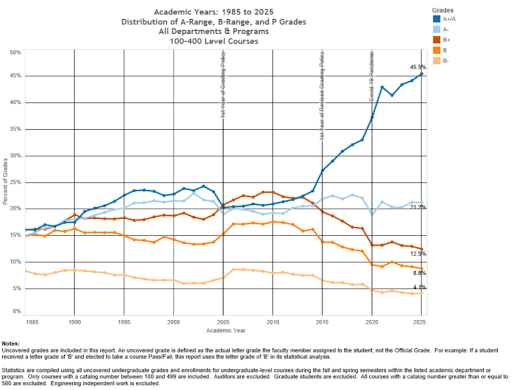
This chart demonstrates a significant change in the number of A+/A- grades awarded at Princeton University. For context, Princeton’s grade deflation policy was implemented in 2004 and ended in 2014. Source: Princeton University Undergraduate Grading Report for AY 2024-2025.
Plenty of theories exist as to the cause of grade inflation, the most likely being that, as elite institutions become more selective, their students on average are even more highly motivated and high-achieving. Gregory noted how “incongruous” it is that universities are “proclaiming how extraordinarily selective [they are],” and at the same time worrying that “the grades are getting better.” Notre Dame’s acceptance rate has fallen by 13 percentage points from 22 percent for the class of 2017 to nine percent for the class of 2029.
Student attitudes on this problem vary across majors and schools, but many students do want the most out of their education, while also wanting their grades to reflect the quality of their work. Harvard sophomore Rohan Ganeshan, a chemistry major, described how faculty have responded to the dean’s report, saying that since its release it has become significantly more difficult to earn an A in “Gen Ed” courses. However, Ganeshan told the Rover he doesn’t “think the solution is a stricter bell curve.” In his estimation, grading should reflect a mastery of the material—or, like a game of golf, pit the student against the course rather than against competitors.
Notre Dame sophomore Patrick Bunal, a double major in economics and the Program of Liberal Studies (PLS), conceded that stricter grading might have some benefits. He notes that his writing classes with stricter grading—which are comparatively rare—are the ones that have driven him to improve his writing skills. According to Bunal, students “want to distinguish themselves in the classroom,” despite the anxiety surrounding the competitiveness of graduate school and job applications.
Dennis O’Connell, a freshman majoring in PLS and honors math, also defended the idea of having more effective grading practices in distinguishing between students, even if the pool of admitted students becomes more and more competitive. He noted, “If the average [student] is better, you may need to shift the [grading] window.”
From the faculty perspective, Deneen argued that professors should undertake “the serious work of promoting excellence,” and that it is best for students to “know with certainty that an A is a genuine achievement.”
Brady Seaburg is a sophomore studying economics, political science, and constitutional studies. He can be reached at bseaburg@nd.edu. He will direct anyone inquiring about his grades to the Notre Dame Registrar.