
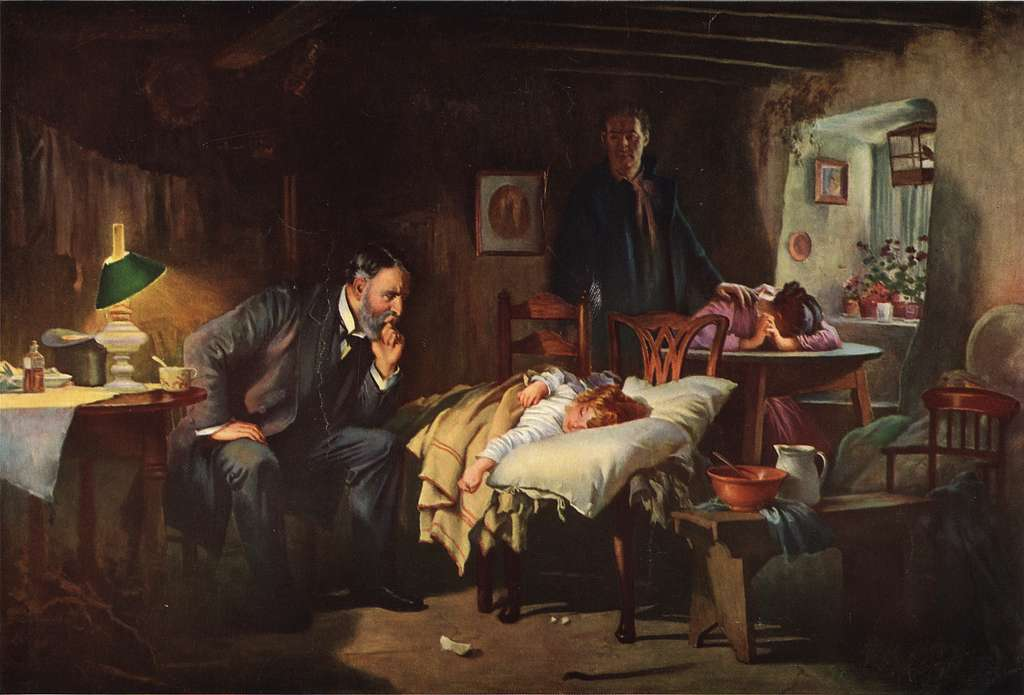
“The good physician treats the disease, the great physician treats the patient who has the disease.” -William Osler, founder of Johns Hopkins Hospital.
The almost universal dread of the doctor’s office is a well documented fact. From the sharp sting of needles to the clinical chill of foreign hands and the potential of bad news, a visit to the doctor is rarely an experience any sane person finds exciting. However, the discomfort often extends beyond physical pain; there is a growing sense that modern medicine has lost its human touch.
As the healthcare industry becomes increasingly commercialized, the patient-doctor relationship has devolved into something cold, transactional, and often detached. While systemic reform may be an answer, Dr. Tod Worner suggests a different solution—one found not in bureaucracy, but in the ‘Great Books.’
In a talk hosted by the Notre Dame Hippocratic Society titled “The Literary Physician: How Timeless Literature Can Revive the Vocation of Medicine,” Worner, an internal medicine physician and Editor-In-Chief of the Journal of Evangelization and Culture, addressed this dehumanization.
He began by identifying significant cracks in the foundation of modern medical training, noting that “the field of medicine is becoming increasingly focused on making you an extraordinary scientist [and] analyst.” In his view, the discipline has become “very materialistic and [has started] to bleed the soul out of the practice of medicine.”
Notre Dame senior George Xu, an incoming medical student at Indiana University, agreed: “the culture of modern medicine undervalues human elements of care like compassion and concern for a patient’s overall life.” He argued that, given the overwhelming “volume of patients,” it is nearly “impossible to care deeply about every individual … without some source of external motivation stemming from faith or a philosophical belief in human dignity.”
Worner’s solution begins with reframing the healthcare profession. He warned that medical training can be “deforming” if it prioritizes technical efficiency at the expense of the human spirit. Worner crafted a sharp distinction between a job and a vocation, defining the latter as “a sacred calling to accompany others.” For a physician to truly succeed, Worner emphasized, he must view the patient not as “a problem to be solved” but “a human being to be accompanied.”
Bethie Benz, a sophomore pre-med student, agreed that medicine values technicality over empathy. In a comment to the Rover, she said, “Modern medicine attempts to cover up the lack of care for patients by requiring students to speak to volunteer and clinical experience while more heavily focusing on student’s capacities for organic chemistry and performance on the MCAT. By introducing pre-med students to this standard at the beginning of their pursuit of medicine, it heavily reinforces an approach to care as something scientific to be mastered, rather than a vocation to encounter the vulnerable—something Dr. Worner emphasized as vital to his approach to medicine.”
Worner proposed literature as a way to bridge the gap between technical skill and human accompaniment. Advocating for the study of classical literature and poetry, he compared literature to the “ballast”—a stabilizing element for a ship on high seas. Literature likewise supports physicians “when the wind starts blowing really hard” and “when things are going really wrong: health, loneliness, and most natural things.” Worner suggested that after reading great works, “you are left with little inner ballasts about the really important things.”
Literature, by painting a more realistic picture of the human condition than medical knowledge alone, allows for a physician to truly understand the human narrative. “The lessons on how to be a doctor don’t come solely from medical literature. … They also come from Dostoevsky, and Jane Austen, and Robert Frost, and Emily Dickinson, and Maya Angelou and William Shakespeare,” Worner said.
He continued, “When you read a novel, you put yourself in place of the hero or the heroine. You feel her difficulty within you, regret her bad choices and celebrate her good ones. Momentarily, they become your choices.”
In the low points during residency or when a doctor is burned out, literature finds a physician at his place in his life’s story, reminding him to look beyond himself and live in the present moments with his patients. In the eyes of Worner, the fullness of life lies in “things that you say offhandedly, or the subtle moments you have with people that seem so small.”
Sadly, living in the present is difficult in the medical field. Sophomore Alex Moon noted to the Rover that “at a certain point, a doctor can get sort of used to human suffering, because they need to maintain a certain level of professionalism.” By engaging in the timeless narratives of other people, a physician can live their vocation without getting lost in the forest of desensitization.
Being a doctor is similar to the journey of Dante in the Divine Comedy. Midway upon the journey of each physician, he must ask the question: “Why keep going?” Literature emerges like Virgil, warning of the hardship that will befall the journey, but also giving hope and motivation to continue. A doctor has promises to keep, and miles to go before he can sleep, and miles to go before he can sleep.
Artur Krutul is a pre-med student and aspiring poet-doctor. When he’s not spitting bars, crashing cars, or puffin’ cigars, he can be reached at akrutul@nd.edu.