
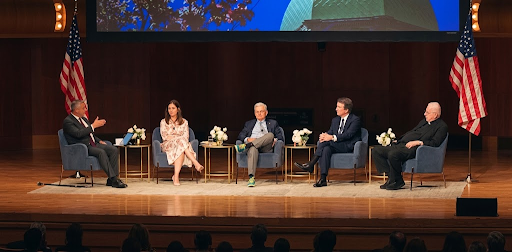
Notre Dame marked the twenty-fifth anniversary of the September 11 attacks this week with a rare, intimate panel hosted by the Center for Citizenship and Constitutional Government (CCCG), giving today’s students a chance to hear directly from witnesses to that day.
Though Notre Dame’s campus held few formal commemorations, the center’s fifth annual Jeanie Poole O’Shaughnessey Lecture ensured the milestone did not pass by unnoticed. Its 2026 event, 25 Years After 9/11, brought together four figures whose lives were shaped by the attacks and whose reflections aimed to educate a generation for whom 9/11 is history rather than memory.
Professor Vincent Phillip Muñoz, director of the CCCG, called it “one of the most important” events the center has ever hosted. Unlike previous lectures, this year’s program took the form of a conversation rather than a formal address. The panelists—Rev. Edward Malloy, President Emeritus of Notre Dame; Jennie Bradley Lichter (’04), former president of the March for Life Education and Defense Fund; James (Jimmy) Dunne III, co‑founder of Sandler O’Neill and Partners; and Associate Justice Brett Kavanaugh—spoke as witnesses to the tragedy.
The discussion opened with a shared recollection: the sheer normalcy of the morning of September 11. Lichter, then a Notre Dame sophomore, remembered feeling the sting of a Saturday football loss as she prepared for her first day of work at the Center for Ethics and Culture. Fr. Malloy was heading to a routine meeting. Dunne was practicing his golf game on a cloudless day. Justice Kavanaugh was in the White House serving as counsel. Terrorism, Lichter said, was not even in the “realm of possibility.”
Then the first tower fell, and the country plunged into chaos.
“Initially, it didn’t make any sense,” Lichter said. No one understood what was unfolding, not even the reporters covering the incident. All she could do was go to work. They promptly told her to leave, and Notre Dame cancelled classes. Students gathered around televisions, watching the tragedy unfold with the same stunned disbelief felt across the nation. “There was no framework,” she said. “It was inconceivable because it had never happened.”
Justice Kavanaugh recalled the fear inside the White House. The Secret Service told the entire West Wing staff to run. They sprinted out of the building without anywhere to go, eventually gathering at the Mayflower Hotel to watch the news. He echoed Lichter’s disbelief: “How could this be happening in America? This doesn’t happen in America.”
Dunne’s account was the most sobering. His company was housed on floor 104 of the South Tower. He spent the morning making frantic phone calls, trying to determine who was alive. He described the moment he realized that Kevin Williams, an employee and caddie he had hoped was safe, was killed. Williams was not just an employee; he was a son, a friend, a beloved colleague. He was only one of more than seventy people Dunne’s firm lost that day.
Yet Dunne also remembered the resilience of the families who gathered afterward. Even within a grave conversation, he offered moments of levity as reminders that hope and human warmth persisted amid devastation. His reflections captured the paradox of 9/11: profound desolation intertwined with great unity.
Even in the chaos, work had to be done. Malloy, then president of Notre Dame, immediately sought to protect students and identify those most affected. He recalled how quickly the campus responded, building an altar by the flagpole, forming a choir, and organizing a Mass on South Quad, over which he presided. “There was utter silence,” he said.
The panelists emphasized that 9/11 was not merely a single day. Its effects rippled through campus life for months. Football games became occasions to honor the fallen, with flags placed on seats and funds raised for affected families. Notre Dame hosted first responders from New York and held its first Blue Mass to honor their service. When Fr. Malloy visited Ground Zero a month later, he saw the rubble firsthand and spoke with first responders and victims.
Lichter described the lingering anxiety among students. Football games, normally celebrations of American spirit, became occasions shadowed by fear of another attack. Studying abroad felt dangerous; students were taught “how to be an American abroad.” Some joined the military to fight the “war on terror.” U2 opened its international tour at Notre Dame and invited first responders to the concert. All this formed part of the post‑9/11 catharsis.
The panelists insisted that we must never forget the unity that arose from the rubble. Lichter remembered watching TV with her roommates and attending Mass with thousands on South Quad. Fr. Malloy recalled students locking arms during the Lord’s Prayer, a “much more intimate and personal” gesture of solidarity. Dunne noted that his community kept his company afloat; he says he could not have survived the loss alone.
The event was designed not only for those who remember 9/11 but for students who never lived through it. The message was clear: remembering 9/11 is not merely an act of recollection but a call to formation.
To this end, the panelists urged the audience to honor the heroes: the firemen and first responders, and the passengers of Flight 93 who sacrificed their lives to protect the nation’s capitol. Dunne emphasized that life will always bring challenges, and we must “prepare early for it.” We need “moral fiber” to make hard decisions. Lichter reiterated the need to “habituate ourselves in virtue” so that heroism becomes possible. One does not simply rise to the challenge on the day; it takes years of spiritual and moral formation to be ready to sacrifice for others.
The panelists also recommended resources to help students understand the gravity of 9/11. Justice Kavanaugh encouraged watching President Bush’s address from Ground Zero, his address at the National Cathedral, his address at the capitol, and his first pitch at Yankee Stadium. Fr. Malloy recommended the play Come from Away for its portrayals of hospitality and unity. Jennie Lichter recommended several articles: Fighting to Live as the Towers Died – The New York Times, which compiles final phone calls and emails and highlights the heroism of Welles Crowther; The Real Heroes Are Dead | The New Yorker, a story of hero Rick Rescorla; Kevin Dowdell’s Boys – The Atlantic, which honors the first responders; and the Flight 93 Cockpit Voice Recorder – Flight 93 National Memorial (U.S. National Park Service).
Finally, when asked which virtue Americans most need to recover to restore unity, each panelist offered a different answer. Dunne emphasized resilience. When asked by the Rover, Lichter pointed to prudence and wisdom in order to recognize the shared goodness in others. Justice Kavanaugh highlighted the need to listen and to seek the good in others. Fr. Malloy urged us to pursue “commonality” in an interview with the Rover.
The evening closed with a call to formation. Remembering 9/11, the panelists suggested, is not merely an act of looking back. It is a call to become the kind of citizen capable of courage, sacrifice, and solidarity.
Abigail Smith is a senior Program of Liberal Studies, theology, and classical linguistics major. When she is not reading for class, Abby can be found singing with the Liturgical Choir and poorly playing volleyball with her friends. Contact her at asmith78@nd.edu.