
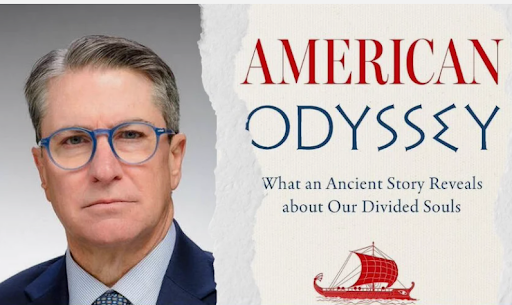
Professor Patrick Deneen delivered a lecture entitled American Odyssey: What an Ancient Story Reveals About our Divided Souls on August 27 in the Eck Center Visitors Atrium, hosted by the Center for Constitutional Citizenship & Government.
Deneen’s talk came on the heels of his new book by the same name, published in July. He outlined the book’s central themes, aligning the story of Odysseus with American identity through the lens of a central tension within both: the simultaneous longing to go elsewhere, to a new place, a new world and the longing for home, the place where we find rest.
“It is a distinctive mark of the American people that we are a people on the move, a nation characterized by what Alexis de Tocqueville called restlessness, inquietude, the inability to be still,” Deneen asserted. He continued, “At the same time, however, we became heirs of another deep longing that equally animated our ancestors, no less than their progeny—the aching yearning for home, the place where we could find rest, where we might live among people whom we deeply know and love.”
Deneen published his first book in 2000, based on his doctoral dissertation, entitled The Odyssey of Political Theory: The Politics of Departure & Return, which also analyzed the Odyssey. However, his earlier work showcased the development of Western political thought in contrast to American Odyssey’s focus on American culture.
American Odyssey was published just four days after the release of Christopher Nolan’s anticipated film, The Odyssey. Coupled with the particular opportunity the 250th anniversary of the United States provides, Deneen saw the reemergence of the classic in American cultural thought as fertile ground for a reexamination of American culture and identity. “Indeed,” he says, “these two events are rather distinct: one more political and historical, the other more cultural and artistic. But I prefer to think of the proximity of these two events as providential, and indeed to appeal to the old—the Odyssean—way of seeing things as a kind of portent.”
Deneen pointed out many similarities between Homer’s epic and American culture, particularly its development. “The journeying of Columbus was nothing more than a repeat and a reiteration of the Odyssean journey itself. It wasn’t just the case that America was discovered by European explorers such as Columbus, in the minds and in the imaginations and in the way that the story was being told in contemporary Europe,” Deneen stated. He continued,“They had a paradigm. They had a frame of reference by which they understood someone venturing forth to find a new world, and that was explicitly Odyssean. It was, in a sense, Odysseus who discovered America.”
Despite the apparent distance between the 2,800 year-old epic or the discovery of America 500 years ago, Deneen posits that the story is intensely personal for each of us as Americans, and not just because of the recent film. “And all of us can tell that story simply by relating our own ancestry. Most of us arrived, in some way, shape, or form, from somewhere, and this may be our home, or our home may be elsewhere. But the intention is to journey somewhere or home.”
Robert Myler, a sophomore in St. Edward’s Hall, recognized the conflicting desires explicitly in his own life. “There is a tension between my desire to be home with my family and the desire to experience all the good things that Notre Dame can give me. The tension is somewhat inescapable, but it has become important to me to not ignore it or try to escape it,” he said. However, he claims to have found a balance: “On the steady foundation my home has given me, I can embrace so many beautiful and exciting opportunities away from home as a student.”
Particular instances and examples that reflect this latent tension from American culture made especially vivid how Odysseus’ own struggles are, in a sense, shared by Americans throughout history. From Dorothy’s journey through Oz that culminated with her timeless incantation, “There’s no place like home,” to George Bailey’s struggle between his desire to build a life outside Bedford Falls and his familial obligation, to the constant movement of the Ingalls in Laura Ingalls Wilder’s enduring set of stories, to name a few, Deneen drew a connection to a deeply ingrained streak that runs through our shared identity and culture.
But there is also danger in the quest into the unknown for more. He pointed out that Odysseus’s unceasing craving led to his placement in the eighth circle of hell in Dante’s Inferno, even though European thought later conceived the tale of hubris to a story as one of human limitlessness. “Indeed, he’s punished for seeking more than that which is permitted to a human being. He is struck down and thereby finds himself in almost the deepest circle of hell—he sought to exceed that which is permitted us, like our forebears Adam and Eve, to have a knowledge that is not permitted to him.”
Sophomore Sabrina Richter was struck by his application of this struggle, specifically as it applies in the present. “Thinking about it that way was kind of eye-opening to me a little bit. Today, society’s sort of endless consumerism focuses on technological innovations that push into new territory. It’s just this infinite pursuit of more satisfaction, of infinite satisfaction, of infinite desire that just keeps going and keeps going and keeps going. Then, on the other hand, there’s this desire for stability and home, that has its unhealthy manifestations nowadays in a sort of complacency.”
However, Deneen proposed that the Odyssey offers a resolution to the tension within the American people. He referred in closing to the blessing that Odysseus is able to acquire upon his return to Ithaca, “to his home, his wife, his child, his city, and perhaps above all, his condition as a human being—as a mortal.”
“The moment that the Trojan War comes to an end is not on the plains of Troy. It’s when Odysseus and Penelope are finally reunited. Thus, the actual ending of the Trojan War ends in the domestic home, the literal bed that Odysseus carved from an olive tree, rooted in the earth. I think in that moment we are offered, in our own tradition, inasmuch as we are heirs of that Western tradition, an enticing, and inviting, and, I hope, a hopeful vision of domestic tranquility.”
Henry Omanga is a sophomore from Houston, TX studying philosophy and psychology with a minor in constitutional studies. If you ever want to discuss the degradation of country music, the best superhero movie of all time (The Incredibles), or niche sports, he can be reached at homanga@nd.edu.