
“It will be one of the most powerful means for good in this country.” – Fr. Edward Sorin
Recent descriptions of Notre Dame’s mission frequently include a phrase that rings hollow. The words “Notre Dame is a Catholic, global research university” are found on the university’s website and within every admissions pamphlet and administrative speech.
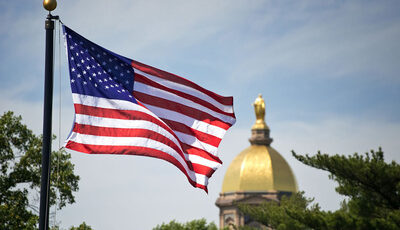
But Notre Dame is not firstly a global university. She is an American university, and she has an authentically American purpose that has largely been forgotten.
As we begin to celebrate 250 years of the Founding Fathers’ great American project, Notre Dame would do well to engage seriously with this American history and purpose—something which lay close to the heart of her own founder, Fr. Edward Sorin.
Irish immigrants faced waves of anti-Catholic prejudice in the decades leading up to Notre Dame’s founding in 1842. Nativist fears, driven largely by Protestants who were alarmed by the number of Irish immigrants entering the country, painted Catholics as a group whose beliefs were antithetical to the culture of the United States. The Know-Nothing Party attempted to rid public offices of Catholics. Signs saying “No Irish Need Apply” frequented shop windows in Northeastern cities beginning in the 1860s, and Irish Catholics were caricatured as a drunken, poor, and dissolute people.
Fr. Sorin’s vision for Notre Dame was in many ways a reaction to the anti-Catholic sentiment that was rampant when he arrived in New York in 1841. The university he established—an American one and a Catholic one—challenged the Nativist prejudice that a Catholic’s allegiance to Rome would in some way impede his loyalty as a citizen of the state. Instead, Fr. Sorin gifted the country with an educational institution that, through its Catholic instruction, would produce more virtuous citizens.
Signs of Fr. Sorin’s efforts are evident here on campus. The now-covered Columbus Murals, commissioned by Fr. Sorin after a 1879 fire in the Main Building, were a physical reminder to every visitor that it was because of a Catholic figure—albeit a deeply flawed Catholic figure—that each American could consider himself as such.
“I think above all,” Notre Dame historian and professor Felipe Fernandez-Armesto explained to the Rover in an earlier column this year, “Columbus appealed to [Fr. Sorin] because [his] vision for Notre Dame … was going to show the world that Notre Dame could be part of the creation of a newer, purer kind of Catholicism than immigrants had left behind in the Old World.”
“It will be one of the most powerful means for good in this country,” Fr. Sorin wrote of his university in a letter to Blessed Basil Moreau in 1842. The native Frenchman understood the enormous evangelical task that stood before the Catholic Church in the shape of America. His Catholic project was accordingly a distinctly American one as well.
Why has Notre Dame shifted its focus in recent years, then, to a “global” identity and a “global” calling to be a “force for good”? Should we be a university that creates citizens of the world?
In some ways, yes. Our Catholic identity is inherently a universal one, and the truths of our faith are ones that really do transcend borders, languages, and cultures. But Notre Dame’s implementation of this global purpose is selective: We are a global Catholic university, but we will not defend the universal truth that “male and female He created them.” We are a global Catholic university, but we cannot include the interests of unborn children in our unceasing quest for global inclusion, diversity, and equity.
If Notre Dame is a global Catholic university, it bears this identity in a much more real sense than the one it currently promotes. A focus on the solubility of borders becomes nothing but a mockery of the institution’s duty to that which is indeed universal—a truth centered on the person of Jesus Christ and sheltered under the watchful care of his Holy Church—if that focus is accompanied by blatant disregard for certain teachings of that truth.
Our country’s need for citizens who can articulate and live out Christian morals is great. Notre Dame’s obligation as an American university is to the future citizens of this republic—citizens whom she is actively shaping. The university’s misplaced priorities between her duties to God, her country, and the world are misleading her students. We are taught first to be citizens of the world, and afterwards to be Americans.
“So what?” you might ask. “What’s wrong with prioritizing our global duty?” To answer this question, we can return to Fr. Sorin. It was because of Notre Dame’s Catholic identity that Fr. Sorin saw the importance of cultivating a sense of civic responsibility in his students. Responsible citizenship and ordered patriotism are both virtues, and the French priest believed that Notre Dame was fulfilling part of her educational duty by forming virtuous Americans. To look beyond the scope of American mores, one must first live out those mores through virtuous citizenship.
The Church is clear about the importance of its role in shaping the moral norms of a society. Which of these norms is Notre Dame inculcating in her students? And how is the Notre Dame education benefiting the country?
Notre Dame’s current global pursuits have led her to forget her American identity, or at least to cease celebrating it. Little has been done by the university to commemorate the past 250 years, which witnessed the founding and rise of an extraordinary Christian nation. Notre Dame’s part in that story, particularly in the story of American Catholics, is something her students should be learning in these next months. Let Notre Dame really live up to her mantra: God, Country, Notre Dame.
Lucy Spence is a junior from McLean, Virginia majoring in piano performance and the Program of Liberal Studies, with a minor in philosophy. Reach her at lspence@nd.edu.
Subscribe to the Irish Rover here.
Donate to the Irish Rover here.