
Before my class of one hundred graduated from grade school—from Mary, Seat of Wisdom School in Park Ridge, Illinois, in 1964—we had a Day of Recollection at our parish conducted by one of the priests who belonged to the Mission Band of the Archdiocese of Chicago.
This priest gave my class two rules of thumb to avoid sin and the occasion of sin: “Do not do in a crowd what you would not do alone,” and “Do not do at night what you would not do in the day.”
Since I did not always remember these rules of thumb, at least not in a timely fashion, I can look back and personally attest to their wisdom. Maybe you can too?
I suggested these rules to my children as they were growing up. And I added one of my own: “Lots of bad things happen after midnight.”
The history of the Church includes a great saint who on at least one occasion violated both the rules of my grade school retreat master at the same time. It is easy to violate both rules at the same time: being with a group at night doing what you would not do if alone or in the light of day.
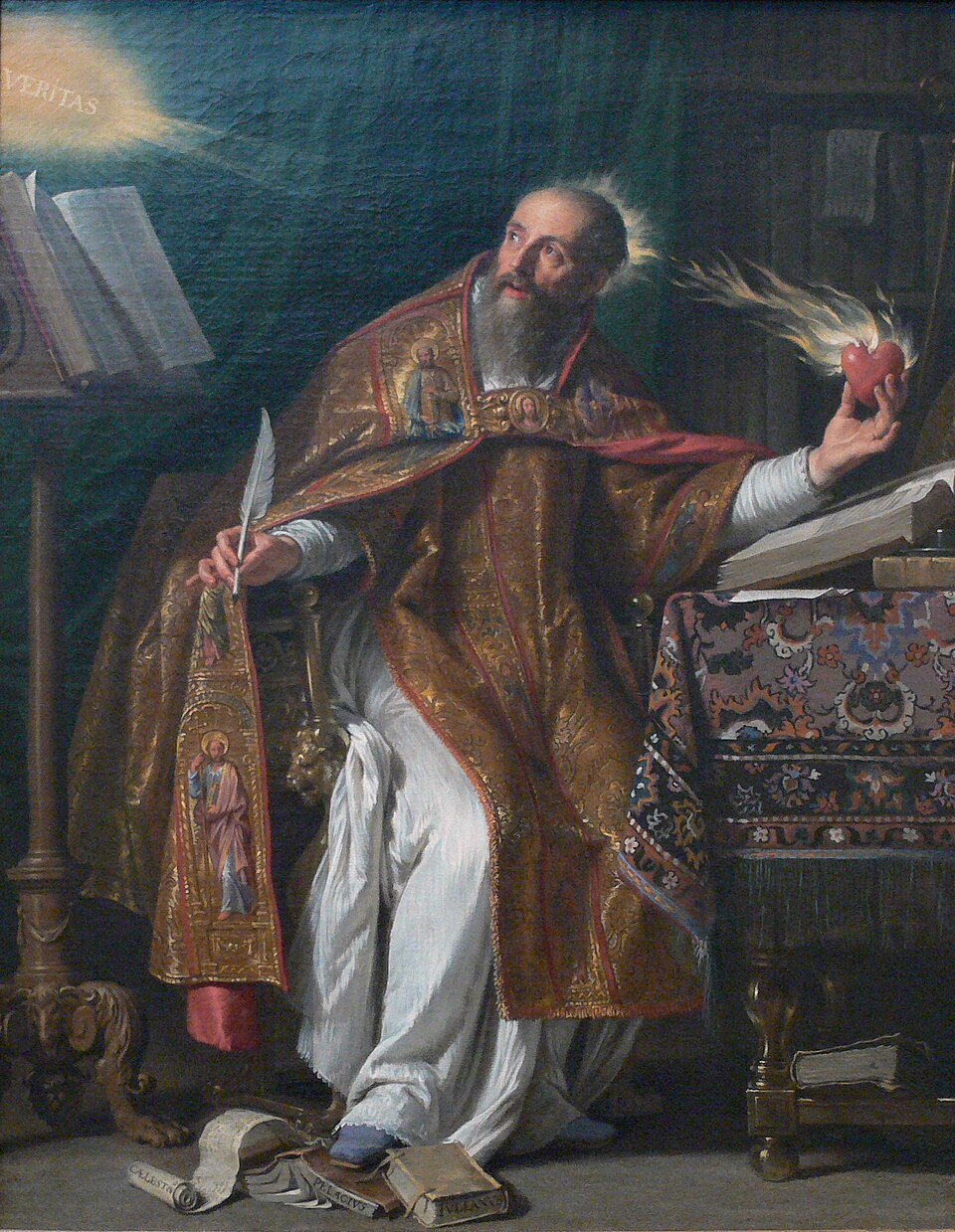
Saint Augustine (354-430 A.D.) was Bishop of Hippo in what is now Algeria. He is a Doctor of the Church, author of The City of God, works on grace and free will, on the Trinity, on the Psalms, on the Book of Genesis, and more. In an autobiography he completed in 400 A.D. while serving as bishop, The Confessions, he related his journey of sin and his quest for truth which led him to baptism in the Catholic Church—the Church of his mother, St. Monica, and the bishop of Milan, St. Ambrose. Augustine converted in 386 A.D., at age 32.
Augustine recounts in The Confessions that, when he was 16, he was with a group of young men his own age: “A group of young scoundrels, and I among them.” It was at night: “It was our bad habit to carry on our games in the streets till very late.” The sin was stealing pears: “We carried off an immense load of pears, not to eat—for we barely tasted them before throwing them to the hogs. Our only pleasure in doing it was that it was forbidden.” It was purely gratuitous: “I was evil for no object … seeking no profit from wickedness but only to be wicked.”
Augustine was 46 when he published his report of this night when he was 16. Clearly, this incident, this sin of unalloyed evil, haunted Augustine for his entire life. One of the benefits of avoiding sin is not being haunted.
A version of this piece was originally published in the New Oxford Review’s Narthex Blog in 2022. It has been reproduced here with permission of the author.
James Thunder is the Secretary of the Class of ‘72; author of over 300 publications in law, public policy, history, biography and religion, including the new compendium of 49 biographies, United States Attorneys for the District of Columbia, 1801-2024, the most famous of which is Francis Scott Key. Thunder has been the facilitator of a parish monthly discussion group on St. Augustine since 2013 and speaks and writes about his ancestor, Augustus Welby Pugin (1812-1852), the Gothic revivalist. (A Pugin-designed plate and spoon, donated by the authors’s father, are with the Raclin Murphy Museum of Art.)