

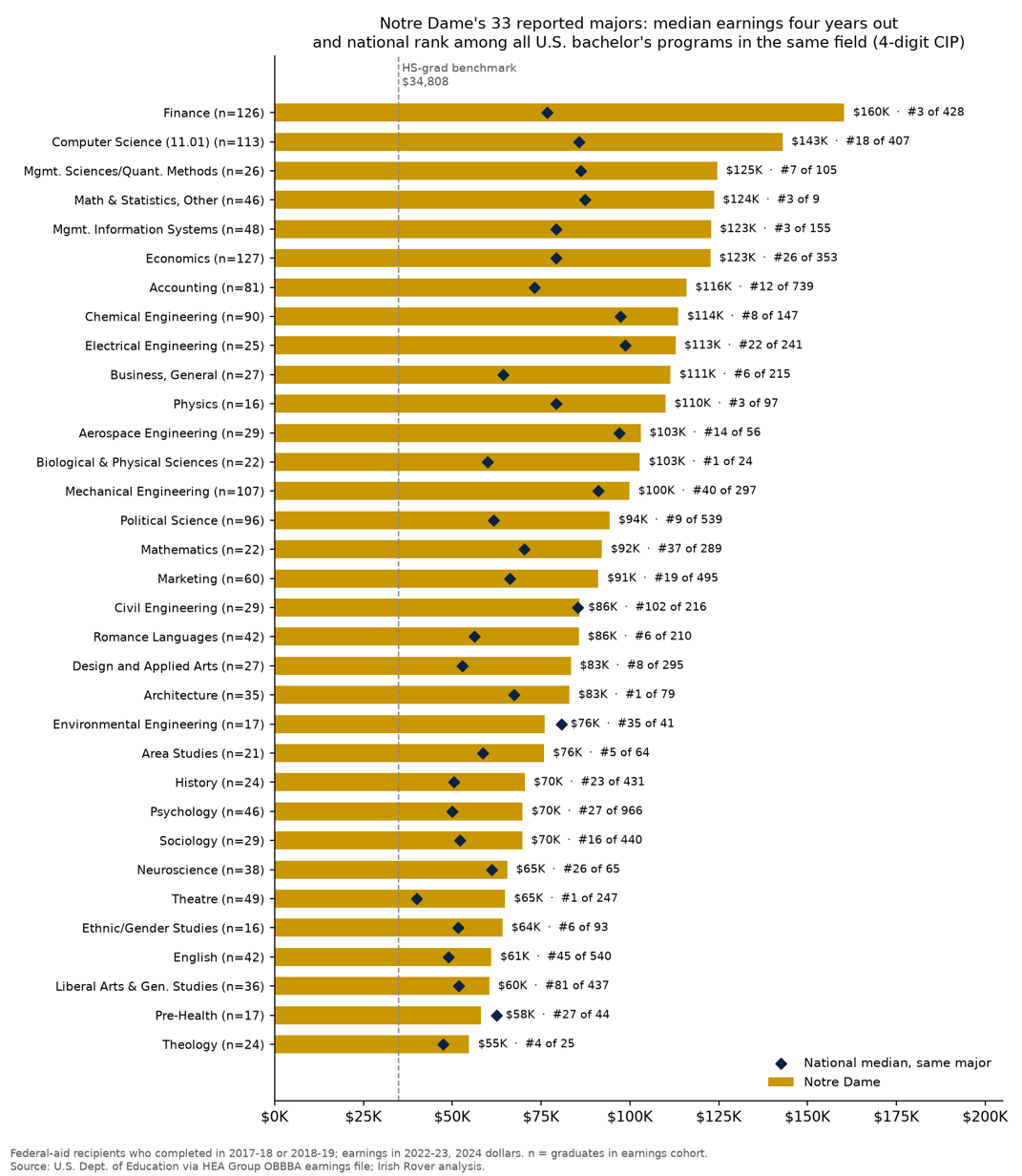
A Notre Dame finance major who graduated in 2018 or 2019 was earning a median salary of over 160 thousand dollars four years later. Only two finance programs in the country performed better: Wharton at University of Pennsylvania and Olin at Washington University.
Notre Dame computer science (CS) graduates from the same year earned 143 thousand dollars four years later—the second highest paying major. It ranks in the 95th percentile of CS graduates across the country, but last among top-20 universities.
Notre Dame graduates of biology and architecture make more than alumni of any other school in those majors.
At the same time, the annual cost of attendance at this university has risen to an eye-watering 91,986 dollars, leaving prospective students asking: Is the price worth it?
The Rover analyzed a Department of Education dataset compiled by the HEA Group, which tracked the median earnings of 2017-18 and 2018-19 graduates of more than 32,000 bachelor’s and associate’s degree programs nationwide four years after they finished. It counted graduates who received federal financial aid and were working and not enrolled in further schooling. All earnings were adjusted to 2024 dollars.
If each Notre Dame program is weighted by its number of graduates, the typical aided graduate earned 103,806 dollars four years after graduation. This ranks 53rd of the 1,721 bachelor’s level institutions, or the 97th percentile. Among the 837 institutions with at least 10 reported programs, Notre Dame ranks 23rd.
The Department of Education initially gathered the data to measure whether graduates of collegiate programs across the country earned more than high school graduates who never went to college. Notre Dame passed with flying colors. Even graduates of its lowest paying major—theology—earn a median of 20 thousand dollars more than those who never went to college.
Economics professor Kirk Doran told the Rover, “ND grads perform very well nationally, and ND econ is no exception to that. Looking at the data, you can see that ND econ is a unique opportunity to study in the College of Arts and Letters—which offers the richest and most varied education on campus—while also earning one of the top salaries of any major at Notre Dame.”
With the exception of pre-health, all of Notre Dame’s lowest paying majors come in the humanities fields, including FTT, English, ethnic or gender studies, Program of Liberal Studies (PLS), and theology to round out the bottom.
Neither is this an indictment of Notre Dame—the average Juilliard graduate did not make more than the high school benchmark four years post graduation. In fact, Notre Dame graduates earn the most out of all 247 schools in the ‘theater’ category.
Indeed, for the university and her students, the purpose of these majors is not primarily a financial one. In a recent op-ed in America Magazine, Father Bob Dowd, C.S.C. wrote, “In a world with A.I., the humanities, which have always been at the core of Catholic higher education, have never been more important.”
Peer Institutions
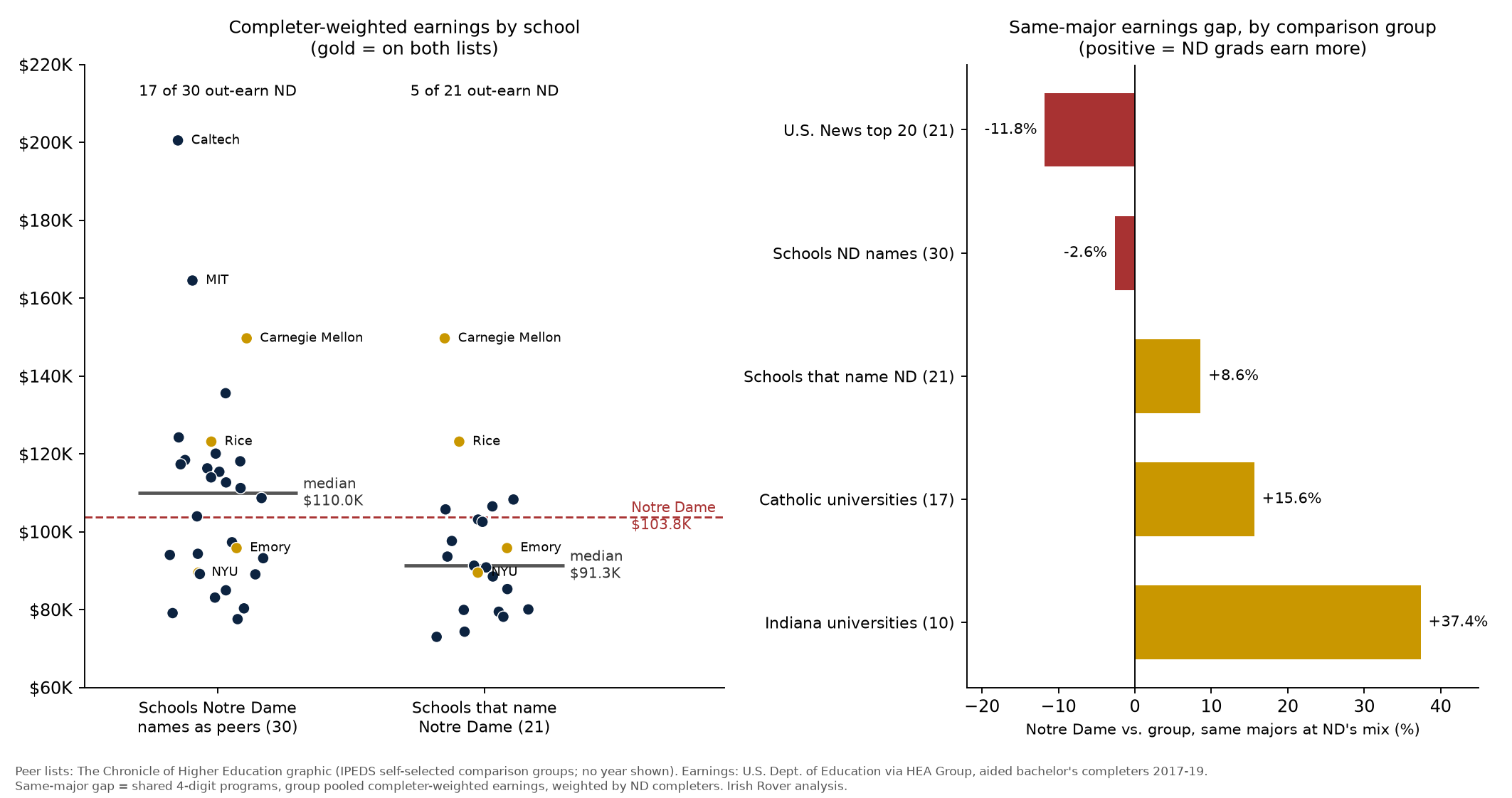
Notre Dame measures its peers in a number of ways. Each year, it reports a list of universities that it considers ‘peer’ institutions. These peers outearn Notre Dame graduates by a modest 2.6 percent, while Notre Dame outearns schools that name it as a peer by 8.6 percent. Meanwhile, Notre Dame graduates earn more than alumni of Catholic universities and Indiana universities by wider margins of 15.6 percent and 37.4 percent, respectively.
Most impressively, Notre Dame falls behind just two of its peers in finance, ranking number three out of 428 finance programs in the country for earnings four years out. Finance is Notre Dame’s largest major with around 300 graduates each year.
The data reveals strengths in the program of which the dean is proud. Dean Martijn Cremers told the Rover, “As dean of the Mendoza College of Business, I’m very proud of what all of our students accomplish.” Further, “As a finance professor, I’m especially pleased to see that success reflected in the … data.”
Cremers attributed success firstly to excellent faculty and curriculum. Finance professor Carl Ackermann echoed this statement, “Since finance is the largest major at the University, the Department of Finance has the resources to offer specialized courses. So firms are hiring students who already have specific training in what they do,” he told the Rover.
Cremers also noted the extensive and active alumni network. Alumni readily mentor and hire Notre Dame students. Cremers said this alumni relationship “provides our students with extraordinary opportunities to learn, build relationships, and prepare to succeed and lead in one of the most competitive industries.”
Cremers testified, “Just as important as preparing students for career success, we also focus on the kind of people they will become.” Notre Dame seeks to cultivate cognizant business professionals who use wealth to contribute to human flourishing.
Caleb Vaughan is a senior from Orono, MN studying chemical engineering—the highest paying engineering major. Cha-ching. He can be reached at cvaugha2@nd.edu.