
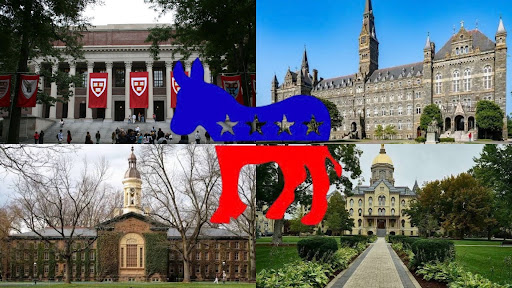
In elite universities across America, liberal faculty members overwhelmingly outnumber their conservative counterparts. This comes as no surprise: American academia has long been disproportionately liberal compared with the American electorate. In 1969, only a quarter of professors were found to be even moderately conservative.
In recent years, however, this ideological imbalance has become even more pronounced. According to faculty studies conducted by the Carnegie Commission National Survey of Higher Education, “between 1969 and 1998, the share of faculty identifying as ‘liberal’ or ‘far-left’ shifted only a tenth of a percentage point, from 44.7 percent to 44.8 percent.”
The UCLA-HERI faculty survey shows a much more significant shift movement toward the left in recent years. Between 2001 and 2015, the share of professors that identified as liberal increased by roughly 12 percentage points. More recent decades have featured a Democrat-to-Republican ratio of around 11:1.
At elite universities, the numbers are more extreme. The Harvard Crimson reported in 2022 that more than 80 percent of surveyed faculty reported to be either “liberal” or “very liberal,” a jump of eight percentage points from the year prior. One percent of faculty reported to be “conservative” and none “very conservative.”
Harvard is no exception, as Yale and Princeton have recently achieved their own liberal benchmark: an absence of Republican-aligned donations among their professors. Yale professors made over 1,000 donations to political candidates in 2025. Not a single recipient was a Republican. The university currently boasts a 36:1 ratio of Democratic to Republican faculty.
As an author for National Affairs observes, religious schools generally “remain far more diverse politically than secular ones … if one wants to be exposed to a broad spectrum of political ideas, it is still far better to attend Notre Dame or Baylor than Berkeley or Cornell.”
At Notre Dame, the ideological imbalance indeed seems to present itself to a lesser degree. A study by the Observer found that 228 professors donated to a Democratic candidate from 2023 to 2026, while 15 donated to a Republican.
Faculty political affiliation does not necessarily dictate what professors teach, but it shapes the range of perspectives represented on campus. Professors at other universities have noted the consequences of a severe political imbalance. Ryan Owens, a professor of political science at the University of Wisconsin-Madison, described his experience on campus in a 2024 interview saying, “That left-wing, dogmatic orthodoxy exists. It’s omnipresent. You can feel it in the air.”
Universities have historically aimed to be bastions of free speech and open debate. At universities like Princeton, founded on a “bedrock commitment to free expression, where thoughtful people of all backgrounds may voice their opinions civilly,” professors are seemingly afraid to speak openly about their political leanings.
The Foundation for Individual Rights and Expression (FIRE) found that, across 6,269 professors at 55 universities, more than half of conservative professors say they hide their views to keep their jobs.
According to several conservative professors at major universities, right-wing beliefs are increasingly being pushed out of universities, with many attributing the current political imbalance to the hostile environments these universities perpetuate. Jonathan Turley, a conservative law professor at George Washington University, accuses professors of having created a “hostile environment for anyone with conservative or libertarian viewpoints.”
There is concern that the more liberal a faculty becomes, the more difficult it is for conservatives to become part of the cohort. Another FIRE survey asked faculty whether a conservative would fit in in their department and 39 percent called such a candidate a “very/somewhat poor fit,” while only three percent said the same about a liberal individual.
As Owens explains, “faculty hire other faculty. And once you reach a tipping point where everybody—or at least the strong majority—thinks one particular way, now they’re able to hire only those who also think that particular way.”
What the ideal political balance among faculty should look like is unclear. However, a grave disparity in the range of perspectives among professors can raise questions about whether a university can foster proper intellectual debate.
Notre Dame places an emphasis on the importance of a diverse faculty, starting with its mission statement: “The intellectual interchange essential to a university requires, and is enriched by, the presence and voices of diverse scholars and students.”
Notre Dame Professor of Political Science Vincent Phillip Muñoz has underscored that a university must encourage an exchange of differing perspectives, “Intellectual diversity, academic freedom, and freedom of speech are means to an end: the end of truth-seeking.”
Jacob Schierl is a sophomore majoring in the Program of Liberal Studies and ACMS from Elmhurst, IL. Reach him at jschierl@nd.edu.