
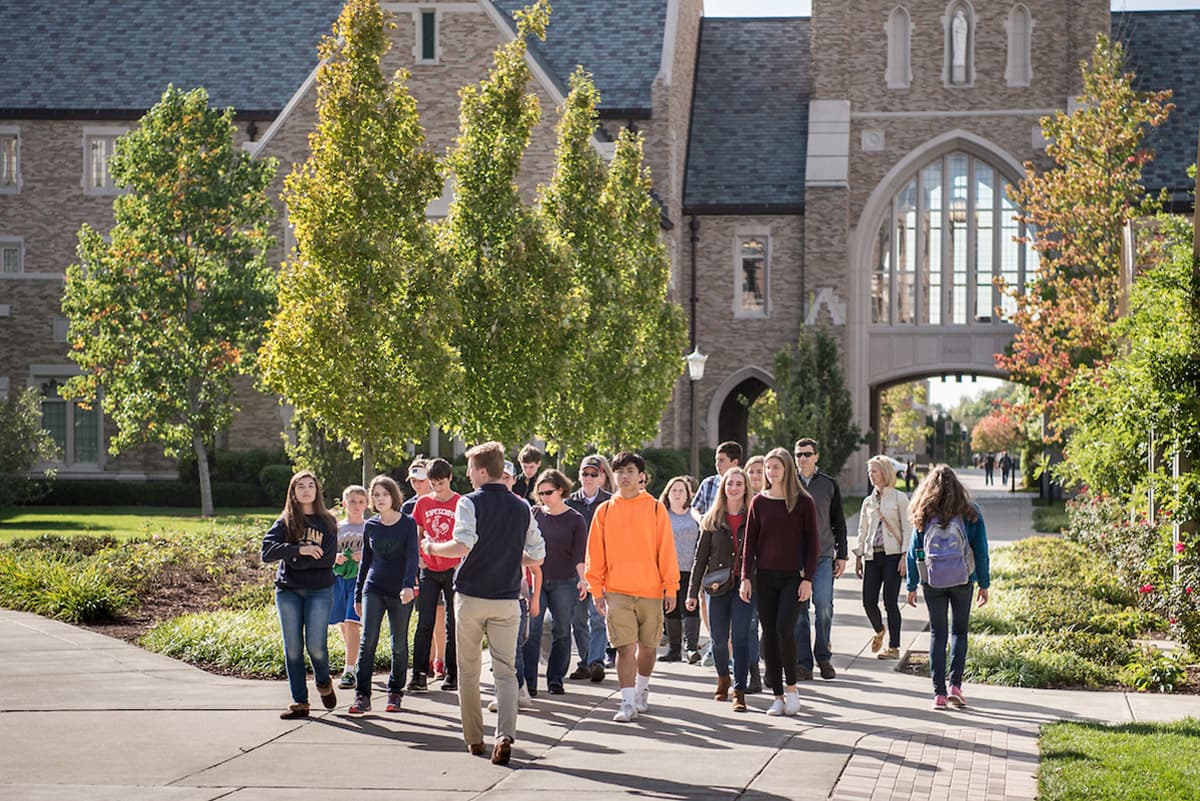
As hopeful high school seniors compete for fewer spots at Notre Dame every year, the acceptance rate for transfer students has remained relatively constant. The Rover spoke with several transfer students about their experiences joining the ranks of the Irish.
The university reports accepting around 200 additional transfer students every year. During the 2024 admissions cycle, 267 students were accepted from 1064 total applicants. This acceptance rate of approximately 25 percent is consistent with reports from prior years.
Students may apply for acceptance to the university from other institutions beginning the spring of their freshman year, with the earliest opportunity for matriculation being the fall of sophomore year. Additionally, there are rounds of application at the mid-semester mark for sophomore students and older. Students may apply to the university up to three times.
The process is very similar to that of Notre Dame’s regular freshman applicants, which emphasize high school records, standardized testing, and a personal statement. On the application, major preference plays an important role: There is limited availability within certain majors, and once accepted, students cannot change their major without the approval of their dean. Additionally, students must provide 24 transferable credits and a competitive college GPA from a prior institution; in past years, this has been 3.75 or higher.
Emaline Morse, class of 2028 and a transfer from Bates College in Maine, recalled her credit-transfer experience, saying, “I was not given a lot of information as to why my classes at an accredited college with a good reputation, like Bates College, were not sufficient for Notre Dame. I was stuck with six semesters of requirements that most students have eight semesters to finish.”
Morse told the Rover, “I took a large overload of classes my first semester, which was stressful when trying to transition into a new school, social, and club life.”
Thirteen years ago, Notre Dame and Holy Cross College developed a guaranteed admittance program, known as the Gateway Program, which annually enables around 90 students to attend Holy Cross College for one year and then automatically matriculate to Notre Dame as full-time students their sophomore year. These students are counted among the transfers to the university.
During their year at Holy Cross, Gateway students take two courses at Notre Dame: the Moreau First Year Seminar and a major-specific course. Oftentimes, Gateway cohorts become tightly-knit communities as they bond through their time both at Holy Cross and Notre Dame.
“The program enabled a smooth transition that has allowed me to excel academically and create more diverse social connections,” Gateway sophomore Andrew Whelan told the Rover.
After acceptance to Notre Dame, all transfers—Gateway or not—are invited with their families to an orientation weekend of their own. It features advising meetings with prospective deans, a Mass with the president, and introductions to their dorms.
Coming from schools who approached community life differently, Notre Dame dorm culture is often notable for transfer students. Chris Dailey, a sophomore transfer from Holy Cross College, commented, “The dorm was probably the biggest difference. … I’m now in Duncan Hall, and I love it. There is a real sense of pride for the hall.”
Though dorm communities are a vital part of student life on campus, transfer students are not guaranteed on-campus housing.
The shortage of room availability on campus leaves some transfer students to find their own housing for the first semester, or even year, of their Notre Dame experience. Notre Dame’s two newest dormitories, Coyle and Grojean Halls, are expected to remedy the housing shortage for the fall of 2026 with an additional 445 beds.
Adjusting to course difficulty at a top-20 university is often a concern for transfer students. Jeremy Lemaignen, a transfer from Fransiscan University of Steubenville in Ohio, told the Rover, “Classes here are more rigorous and conceptually difficult than at my prior college. But,” he continued, “I’ve also noticed that the engineering professors at Notre Dame write very fair tests. So far, I haven’t gone into any exam worried about trick questions or unfair grading.”
Transfer students are also encouraged to attend the Club Fair at the beginning of the year in order to become accustomed to the extracurricular offerings on campus. As is true for incoming freshmen, each student has a level of autonomy in making their experience at Notre Dame unique.
Although the process of becoming involved in dorm culture, clubs, and other opportunities can be difficult, the pay-off is ultimately worth it for many. Dailey told the Rover, “Transferring teaches you about discipline. Every day, I knew my goal. I woke up and chased it.”
Bethie Benz is a sophomore theology and pre-health major who was also a Gateway transfer herself. She is currently fighting strong negative thoughts about the frigid weather outside but is thankful she no longer has to make the “multiple times daily” trek to-and-from Notre Dame’s campus. She can be reached at ebenz@nd.edu.