
The Center for Citizenship and Constitutional Government (CCCG) hosted a debate on October 28 titled “Socialism, Populism, Centrism? The Future of Left Politics in America.” The event was co-sponsored by the Notre Dame Democracy Initiative, and was held less than a week before the November 3 midterm elections.
Bhaskar Sunkara is a prominent left-wing journalist and the founding editor of Jacobin, president of The Nation, and the author of The Socialist Manifesto. He is also the former vice chair of the Democratic Socialists of America, the nation’s largest socialist group, which favors public ownership of major industries and an elimination of the branches of government. During the debate, Sunkara described himself as being “on the far left” and called his vision “fundamentally social democratic.”
Defending the centrist position on the panel was Matt Yglesias. Yglesias is a self-described left-wing pragmatist who founded Vox, is the author of the Slow Boring newsletter, and is a contributing opinion writer for The New York Times. During the debate, Yglesias referred to himself and his allies as “DC moderates.”
Rogé Karma, a staff writer at The Atlantic, moderated the event. Karma graduated from Notre Dame in 2018, where he was a Tocqueville Fellow. The event began with opening remarks from each panelist, followed by a moderated discussion and audience questions.
Sunkara argued that the central problem facing the left is what he called “class dealignment,” clarifying that “the association of the poor and working classes with parties of redistribution has shattered.” He elaborated, “It used to be taken as generally automatic that 60 to 70 percent of people from the working and laboring classes would be, all things being equal, more predisposed to vote for the parties of redistribution.”
According to Sunkara, without the working-class base, left-wing parties just become “assemblages of different special interests.” He continued, “That’s how you end up with a party like the Democrats under, let’s say, Hillary Clinton in 2016, being perceived as being radical, because on individual issues they actually were influenced by extremely passionate—and at times radical people—while still offering no compelling overarching narrative for ordinary working-class people.”
Although the panelists agreed that contemporary Democratic leadership is failing to address the needs of the working class, they disagreed on how responsible the party is for this outcome. Sunkara blamed economic forces like automation and globalization saying, “I don’t think the Democratic Party abandoned working-class people so much as the economy abandoned certain groups of working-class people and the Democratic Party didn’t respond effectively.”
Alternatively, Yglesias directly blamed the party’s abandonment of the working class on environmental elitism claiming, “The primary thing that has driven class dealignment globally is the rise of environmentalism.”
He also blamed the party’s failures on its inclination to go farther left whenever they encounter a loss of popular support for specific policies. “When you do that, you develop a party which, since 1996, is like a car whose steering wheel can only go left. They’ll say, “We lost a lot of Muslim voters, so we’ll go to the left on Israel.’ It’s never that ‘I’m going to try to court Muslim voters by being more open to traditionalist views on gender identity.’”
Yglesias claimed that the Democrat leadership, by trying to attract fragmented groups of far-left cohorts, have become too disjointed and distracted to attract the average working class citizen. He explained, “On crime, people on the left are very comfortable talking about how poverty can be a source of crime, but they fail to acknowledge that high levels of crime can be a source of lack of economic opportunity.”
On that same note, Yglesias also claimed that the left has ceded patriotism to the right. “You imagine a guy who has a flag flying outside his house, and you’re imagining a Republican, right? Because the sentiment of patriotism is just associated with a political right. I don’t think you’re going to have redistributive politics in a country where people don’t believe in the national community,” Yglesias said.
Sunkara echoed Yglesias’ communal sentiment, stating, “What I would like to see is a Democratic Party that spends more time investing itself into things like candidate recruitment of working-class candidates, that has less litmus tests.” He articulated a political vision based on “respect for yourself, respect for your obligations to your family, respect for your obligations to your community,” rather than an exclusive set of progressive social policies.
Despite their disagreements, both panelists criticized a politics organized around specific identity groups. Sunkara warned against treating the party as a collection of ‘separate little groups’ and said he would be “perfectly comfortable with far more Democrats running for office who are pro-life.” Yglesias also said that Democrats should be more open to culturally conservative voters in an effort to appeal to the broader working class.
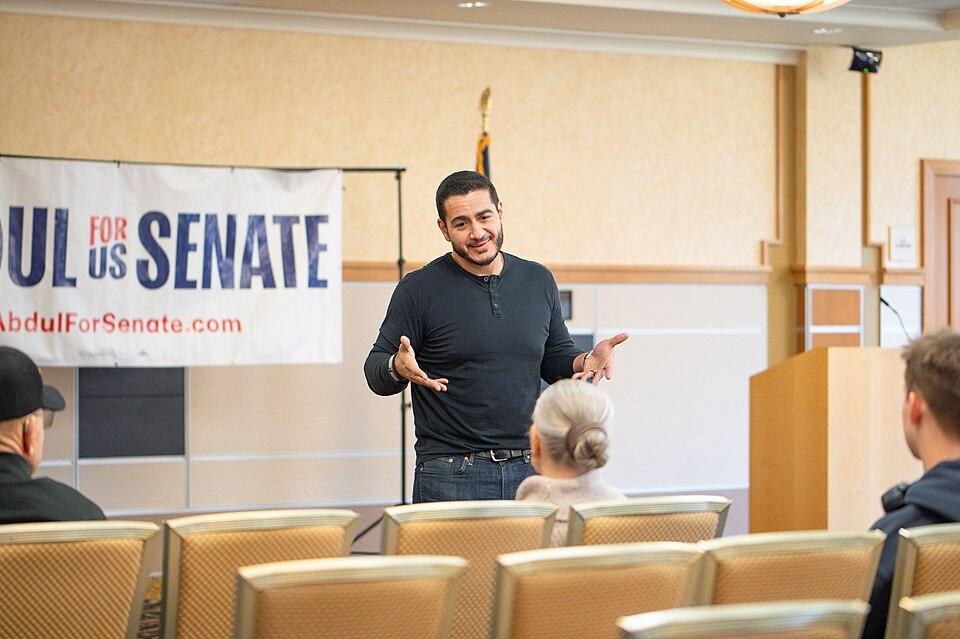
The panelists’ disagreements came to a head over Abdul El-Sayed, the socialist Senate candidate in Michigan. Sunkara called him a ‘great candidate’ and praised El-Sayed for saying young men need more than legalized marijuana and gambling apps. “It’s just objectively a vice,” Sunkara said of marijuana. Yglesias said that being “more left-wing on economics and talking about Medicare for All without giving any ground at anything doesn’t actually capture any working-class political upside.” Yglesias predicted that El-Sayed would underperform in midterms due to being too progressive.
When an audience question raised concern over whether the panelists’ efforts to attract socially conservative working-class voters would undermine essential social justice concerns, Yglesias said that even populist candidates tend to drift toward conventional progressive positions as their campaigns gain momentum.
Luke Severson is a sophomore political science major. His favorite hobby is listening to Dr. Taylor Marshall lectures. Contact him at lseverso@nd.edu.