
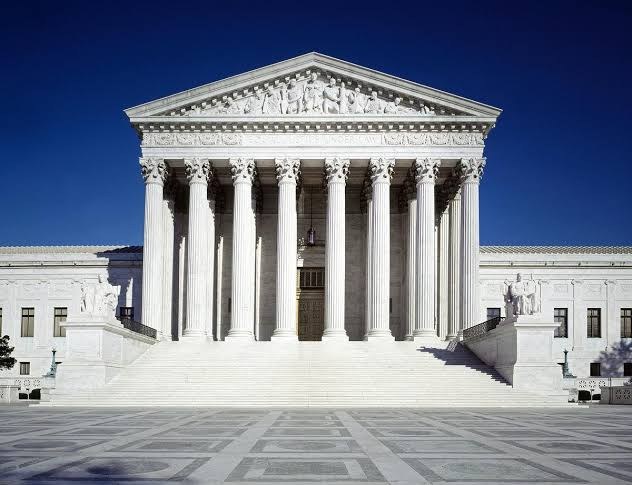
Notre Dame Law School’s Lindsay and Matt Moroun Religious Liberty Clinic filed an amicus brief with the Supreme Court in Nathan v. Alamo Heights Independent School District, a case disputing a Texas law which requires every K-12 public school classroom to display a poster of the Ten Commandments.
Filed on September 28, 2026, the brief sides with 16 Texas families who claim the law—Texas Senate Bill 10—is a violation of the First Amendment’s Establishment Clause. A federal trial court issued a preliminary injunction against the law, but in April 2026, the U.S. Court of Appeals for the Fifth Circuit reversed the injunction, upholding Senate Bill 10. On August 17, the families filed a petition for writ of certiorari, asking the Supreme Court to deliver a final ruling.
In an interview with the Rover, Associate Clinical Professor of Law, Director of the Religious Liberty Clinic, and leader in the brief John Meiser, stated, “A misunderstanding that you see a lot in some of the coverage about this case is—and often in these cases about religious freedom or First Amendment rights—they are presented as something like … there’s one side that’s pro-religion, if there’s something going on that’s otherwise supporting or promoting religion, there’s a side that recognizes the Constitution protects that, and there’s a side that is anti-religion. That is not what this case is about.”
The Religious Liberty Clinic does not oppose religious expression in public life, according to Meiser: “Scrubbing our public spaces, our political debates, and so forth of religion is a serious threat to both religious freedom and political flourishing. … But this case is about the line the Constitution draws against the government itself using its coercive powers to teach a view of religious truth.” Meiser explained, “Since the Founding, our Constitution has recognized the danger of opening the door to that kind of government control over religion, and it’s critical in my view that people who otherwise care about religious freedom do not shy from defending against that threat, as well.”
Meiser emphasized that the brief’s focus is to highlight the difference between individual religious exercise and government-mandated religious instruction. He explained, “To point out that the Constitution defends against [the latter] is not to deny the importance of religion or religious education or anything like that. It’s to recognize that there are appropriate roles of the government and parents in the private sphere.”
“On one hand, it has to be true, as the case Kennedy v. Bremerton held, that the Establishment Clause does not require or even allow the government to scrub all religious things from public life. But it is also true that the Establishment Clause does limit the way the government can bring in religion. This case asks some important questions on where that line is,” Meiser said.
According to Douglas Laycock, Robert E. Scott Distinguished Professor of Law Emeritus at the University of Virginia School of Law and prominent collaborator on the brief, the goal is to “try to preserve religious liberty for school children,” as he said in his statement to the Rover. “Children are more vulnerable, they’re a captive audience, and they have to be there,” he went on to say.
Laycock added, “Things posted in the classroom are things you’re supposed to learn. Stopping the Ten Commandments displays in the classroom is about preserving individual choice and freedom with respect to religion.”
Similarly, Meiser wrote to the Rover, “We have to hold onto a real principle—a constitutional principle—and in my view that principle is that the government can’t force people, using its coercive power, to take religious instruction.”
In support of Texas Senate Bill 10, Texas Attorney General Ken Paxton released a statement saying, “There is no reason any school district should be prohibited from displaying these foundational words that have guided our laws and values for centuries. The Ten Commandments reflect principles that shaped both our State and our nation, and students benefit greatly from being able to learn from them daily.”
In the Fifth Circuit’s ruling, the court stated, “Senate Bill 10 looks nothing like a historical religious establishment. It does not tell churches or synagogues or mosques what to believe or how to worship or whom to employ [and] … punishes no one who rejects the Ten Commandments, no matter the reason. It levies no taxes to support any clergy. It does not co-opt churches to perform civic functions. These are the kinds of things ‘establishments of religion’ did at the founding. Senate Bill 10 does none of them.”
On the other hand, the brief’s collaborators claim that the Fifth Circuit’s ruling set a dangerously loose precedent for lower courts with regard to state-sponsored religious instruction. In an interview with the Rover, Nathan Chapman, the A. Gus Cleveland Distinguished Chair of Law at the University of Georgia School of Law said, “The lower court ignored prior decisions [such as Stone v. Graham] that were on point with this case on the grounds that they had not sufficiently relied on historical practices and understandings.” The decision relied, in part, on Lemon v. Kurtzman, which established a standard that has since been cast out by the case Kennedy v. Bremerton.
Chapman said the brief’s collaborators believe a decision in favor of Nathan “is fully supported by the history.” He emphasized, “The lower court was not following precedent, and if the Court doesn’t fix it, then other lower courts will not know whether they are obligated to follow precedent in this area as well.”
Chapman continued, “We think it’s a pretty dangerous interpretation because it’s difficult to distinguish the Ten Commandments law in Texas from a law that would require reading the Bible in school,” which would be “contrary to a lot of students’ beliefs.” He explained that such a decision would “leave in place a decision that opens the door for all kinds of indoctrination in public schools.”
When the Rover asked her thoughts on the brief, a sophomore in Grojean Hall said, “I do not think that public schools should put any type of religious teachings in a classroom. I think that if a different religion, such as Islam, would put a verse from the Qur’an in a public school classroom, it would immediately get shot down.” She argued that if parents would like to impart religious values to their children, they should send their kids to a private school. “Parents who send their children to these schools … have an understanding that these teachings will be implemented into their child’s curriculum.”
Seven other students whom the Rover interviewed sided with Notre Dame Law School’s brief, each arguing that religious expression should not be mandated in public school classrooms.
Those who worked on the brief do not agree on everything about the case or the constitution. Their explicit point of agreement, according to Meiser, is: “historically and today the First Amendment prohibits the government from ordering children to receive devotional religious instruction.”
Colin Milligan is a sophomore PLS and theology major. His favorite hobby is reading and writing poetry. Contact him at cmillig5@nd.edu.