
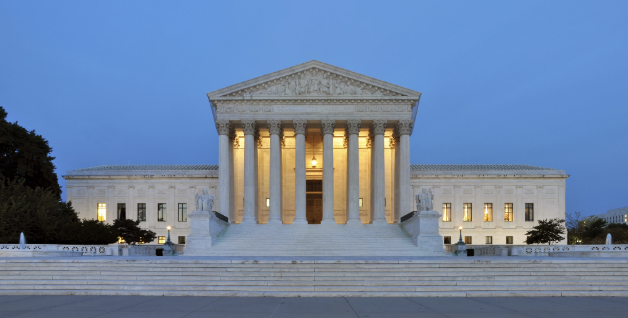
Notre Dame law professors and students filed an amicus brief with the U.S. Supreme Court on September 14, urging the court to reevaluate the 2004 case Locke v. Davey, which infringed on religious liberty in higher education.
The brief urged the court to overturn Locke via two ongoing cases, Hall v. Fleming and Johnson v. Fleming. Major institutions to file include the Lindsay and Matt Mouron Religious Liberty Clinic, the Notre Dame Law Project, the Notre Dame Program on Church, State, & Society, and the Union of Orthodox Jewish Congregations of America (Orthodox Union).
A ruling in favor of the plaintiffs in the Hall and Johnson cases could overturn Locke, which allows states to uphold statutes that permit certain scholarships to deny recipients funding based upon their intent to study a topic related to religion. Even though the court has narrowed the definition of Locke, it still allows for the exclusion of those who seek religion-adjacent degrees.
In an email to the Rover, Nicole Stelle Garnett, the John P. Murphy Foundation Professor of Law, described Notre Dame Law School’s involvement with the brief. “Because of our Catholic mission, Notre Dame Law School has a commitment to religious liberty and educational freedom, and this is an important case raising both issues,” she wrote.
An amicus curiae brief, named for the Latin phrase meaning “friend of the court,” permits interested individuals or organizations to provide relevant information that pertains to a case and may have been overlooked.
Professor Rick Garnett, the director of the Program on Church, State, & Society, explained why the program contributed to the amicus brief in an email to the Rover. “The Hall case is directly related to the Program’s mission, because a strong constitutional rule against religious discrimination helps to facilitate the full participation of religious institutions in public life.”
Under Locke, both Rick and Nicole Garnett see potential issues for students pursuing advanced degrees, particularly in the Masters of Divinity program, Nicole Garnett said that even undergrads who pursue theology degrees could potentially be impacted by the ruling. Overturning Locke would open up scholarship opportunities previously closed by the ruling.
In the Hall v. Fleming and Johnson v. Fleming cases, the State of Virginia denied two Liberty University students, Bethany Hall and Cameron Johnson, funding from Virginia’s Tuition Assistance program. The amicus brief supports the students, who claim that the discrimination on the basis of their religious studies violates the Free Exercise Clause of the First Amendment.
Professor Rick Garnett commented on this issue. “At a general level, the case is about discrimination against religion,” he wrote. “More specifically, although the Supreme Court has ruled a number of times that governments are not allowed to exclude religious beneficiaries and participants from benefits programs on the basis of religion, a number of programs continue to do so, if the participant is or could be preparing for religious ministry.”
“Locke is hard to square with contemporary First Amendment doctrine and the overriding rule that the government simply can’t discriminate against religious people in funding programs,” Professor John Meiser, Director of the Lindsay and Matt Mouron Religious Liberty Clinic, wrote to the Rover. “And as long as Locke sits on the books, it frustrates a consistent application of that rule by leading many states to stand by religious exclusions that cannot be constitutionally justified.”
In an interview with the Rover, second-year law student Matthew Krauter also mentioned this inconsistency and his frustration. “One of the judges [in the Hall case] agreed that it’s about time Locke gets overruled, but his hands were tied. He’s bound by the Supreme Court until they take the step to overrule it. They can’t do anything. So the courts agree with us that it’s time for [Locke] to go. We’re just asking the Supreme Court to recognize where they’ve already been heading.”
Krauter called attention to the resources available to students in finding unfair statutes. “If you’re curious about these things, you should check out our religious discrimination tracker website,” he said. “Stay up to date with religious liberty stuff like our clinic; the religious liberty clinic at the law school does a lot of really good work filing amicus briefs on important cases.”
When asked why she is passionate about the Locke case, Garnett explained that educational choice and religious liberty are two primary focuses of her scholarship. She commented, “There has been great progress in advancing religious liberty and educational choice, both in the Supreme Court and in education policy, and Locke is both out of step with those developments and relegates believers to second class citizenship. I think the case was wrongly decided in the first place, and hope the Court will rectify that problem.”
Jack Woodiel is a freshman from South Bend majoring in statistics. He enjoys being in nature, playing guitar, listening to folk music, and occasionally all three at once. Contact him with questions you have or answers he needs at jwoodiel@nd.edu.