
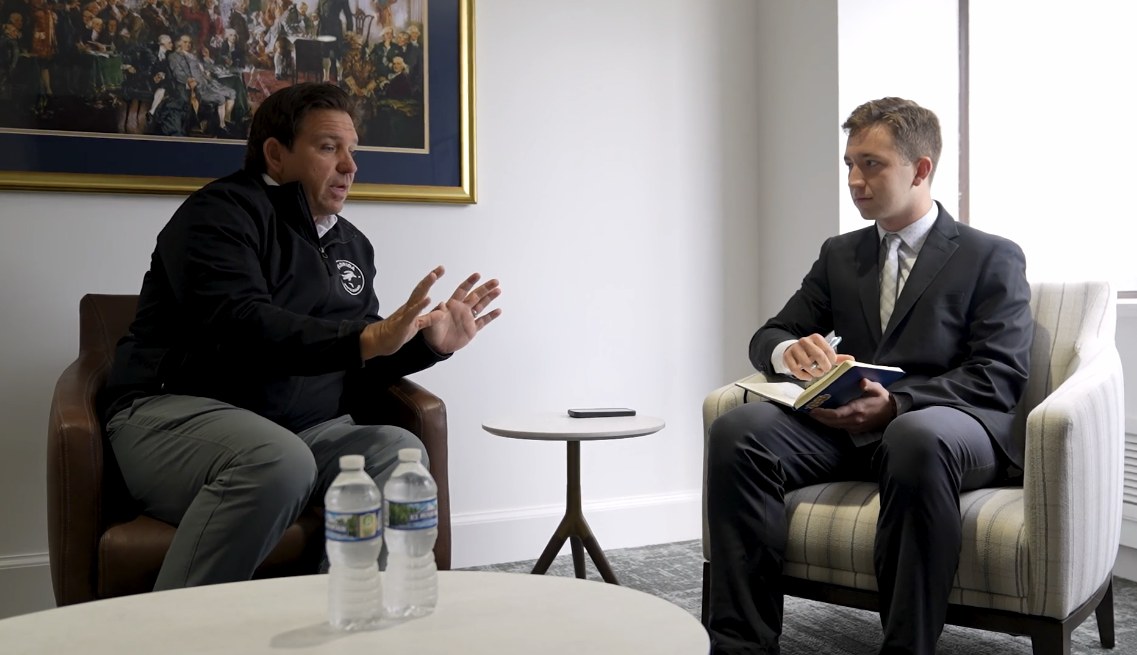
Come January 5, 2027, Governor Ron DeSantis of Florida is a free man. Throughout two terms, DeSantis won favor in Florida and across the nation for his leadership throughout the COVID pandemic, reform of Florida schools, and fights against ‘woke’ social policy. Despite a razor-thin victory in 2018, DeSantis won reelection in a landslide in 2022.
The Rover sat down with DeSantis to recap his eight-year tenure and discuss his future plans and the results of the 2026 midterms.
Presidential Campaign
DeSantis ran for president in 2024, but bowed out after placing a distant second to Trump in the Iowa caucus. Many speculate that he will run again in 2028. As it stands in 2026, DeSantis, alongside Vance and Rubio, are clear frontrunners for the Republican nomination in 2028.
Contrary to a report by the Washington Post, DeSantis told the Rover that he does not yet have plans for a 2028 run. “You can’t trust these folks,” he said, echoing the president’s distrust of mainstream media.
DeSantis, however, did not reject the possibility of a 2028 presidential campaign.
Ultimately, Desantis’ decision will come down to whether he sees a viable path to election. “We need an improvement in the political climate for Republicans to be competitive in ‘28,” he said. “The reality was if we ran George Washington on Tuesday with an (R) by his name, he would have lost.”
Even if Republicans could win the executive branch, DeSantis expressed doubt that a Republican legislature would be possible at any point during the upcoming presidential term. “With how polarized our country is, even if a Republican could win in ‘28, … say you win a couple senators, you have 54 Dem senators. They’re going to have the House. What are the prospects of having an agenda that can actually move the country in a good, solid, conservative direction?”
A majority blue legislature “undercuts our ability to really have a positive agenda going forward,” he added. “Anything I would do is to really make an impact and to leave a lasting positive mark. The reality is you can’t do that just with executive orders.”
Part of DeSantis’ success in passing legislation in Florida is due to Republican control of both houses of the state legislature throughout his tenure. Since the 2022 elections, Republicans have held a two-thirds super majority in both chambers.
The Midterms
So why did Republicans lose so much ground in the recent midterms? Many point to a shift in younger voters. This includes the Gen Z vote, which DeSantis is optimistic towards. He told the Rover, “I think it’s recoverable.”
“I don’t think it was that the young people shifted blue. I think it was like the young people that voted blue two years ago came out, and the ones that voted red didn’t vote. I mean, I think it was more just the lack of turnout. But you know, that’s a problem too because you got to inspire people.”
“I don’t think those people who voted for Trump who then didn’t turn out this time are all of a sudden flaming liberals,” DeSantis added.
The focus of political ads is also a strong indicator of voter sentiment. “Democrats were running—yes, on cost of living prices—but very heavily on the corruption in Washington and the self-dealing.” He continued, “If you talked to the voters and looked at the data, [corruption] was a big issue for a lot of voters.”
Voters watched as politicians’ wallets got thicker while prices on gas, groceries, and other goods rose across the country due to tariffs and the Iran War.
When DeSantis first ran for the U.S. House of Representatives, an endorsement from Trump helped him win the Republican primary with little political clout. The Rover asked whether Trump’s endorsement will carry the same weight following the Democrats’ midterm blowout. To what extent will Trump have a say over the next Republican nominee?
In response, DeSantis indicated that he does not view the midterm results as a total rebuke of Trump. “If we had an Iowa caucus next month, [the Republican base] would re-nominate Trump. If we had a South Carolina primary, Republican primary voters would re-nominate Donald Trump.”
“[Trump’s] endorsement would be a major thing. Anything that tells you it won’t be influential [is wrong].”
Catholic Faith
In response to the question, “What does [your Catholic faith] mean to you? How does it change your daily life?,” DeSantis described his faith as a “cornerstone” and “foundation.”
“It keeps you focused to true north, and I think it’s allowed me to be a much stronger leader,” he said. DeSantis did not elaborate on his personal practice of the faith, however.
Higher Education
The Rover asked DeSantis about American higher education and its significant lean to the Left.
“If you’re an outspoken conservative, especially in [liberal arts fields], I think the chance of getting tenure at a lot of these universities is low. If you bottle up those beliefs, your chances go up. If you fake Left wing beliefs, your chances go up even more,” he said.
“But why would we want to be in a situation where that would be the case?”, DeSantis questioned.
“You look at Harvard, Yale, Princeton, all these. It’s like 99 to one in terms of faculty donations, Democrat to Republican. And I think Yale even one time was 100 to nothing. They didn’t have a single faculty member donate to a Republican.” Recent reports coming out of these three Ivy’s confirm that faculty donate almost exclusively to Democratic candidates and causes.
At Notre Dame, the political ratio is nearly as pronounced. A recent Observer report showed that 93.8 percent of faculty political donations have gone to Democratic candidates and causes. However, City Journal noted that the 6.1 percent of donations that go to Republican candidates and causes represents one of the 20 highest shares in their rankings of 115 schools.
In 2016, DeSantis passed a law banning public universities from spending state or federal funds on DEI programs or offices, and certain DEI-related general education courses. It also reassigned faculty hiring authority to university presidents, and by extension, the Boards of Trustees. This law was intended to disentangle hiring decisions from the opinions of the current faculty who would theoretically support continued left-wing entrenchment, DeSantis said.
“Say you have a great guy at Notre Dame who we want—we can go offer them, bring them to the Board of Trustees, and our board can grant them tenure without having to go through the existing faculty,” DeSantis explained. “This way, people that are more conservative aren’t going to be blackballed.”
“We also have post tenure review, so all tenure professors now have to go under review, and they can be terminated for poor performance,” he added. “And so, making sure that the faculty is really focused on pursuing truth and robust debate and facts and not ideology has been huge for us.”
The threat of withholding accreditation, DeSantis said, is also a major check against DEI. “Some accreditors say you have to have DEI, otherwise you don’t get accredited.” In that case, a college’s hands are bound, DeSantis argued. This creates “an alternative accreditor.” DeSantis is working with the Trump administration to create an alternative national accreditation system that does not reward DEI practices. “You won’t get accredited if you have DEI,” he told the Rover.
While DeSantis was on campus, he had lunch with the undergraduate Tocqueville Fellows and engaged in a fireside chat with professor Vincent Philip Munoz in front of an audience at the Center for Citizenship and Constitutional Government. He also stayed to watch the Fighting Irish take down the Miami Hurricanes. He told the Rover that his son, Mason, was repping the Irish.
Caleb Vaughan is a senior from Orono, MN. If you think he should run for president, either now or when he becomes age-eligible in 2040, send him a note at cvaugha2@nd.edu.